

This article is brought to you by laptopreview.club (笔记本电脑评测网) in collaboration with the renowned tech reviewer Golden Pig Upgrade Package (金猪升级包). We're bringing you an exclusive breakdown of the Intel Core Ultra 300 series.
This English version was translated and adapted by tech reviewer Vitamin P (维生素 P), combining insights from both the original video and the Chinese article. Some chapters or content in the text were added by the translator Vitamin P.
- Original Chinese Article: 英特尔 Panther Lake 酷睿 Ultra 300 系列产品线解析- laptopreview.club
- Original Video: 期待核显新王的精彩发挥吧,英特尔 Panther Lake 产品家族解析 - Bilibili
Overall Product Positioning
Unlike the Arrow Lake and Lunar Lake series of 2024, Panther Lake stands as the sole codename within the Core Ultra 300 series. This generation is exclusively designed for mobile laptop platforms—probably there will be no desktop versions, nor will there be any high-performance HX models.
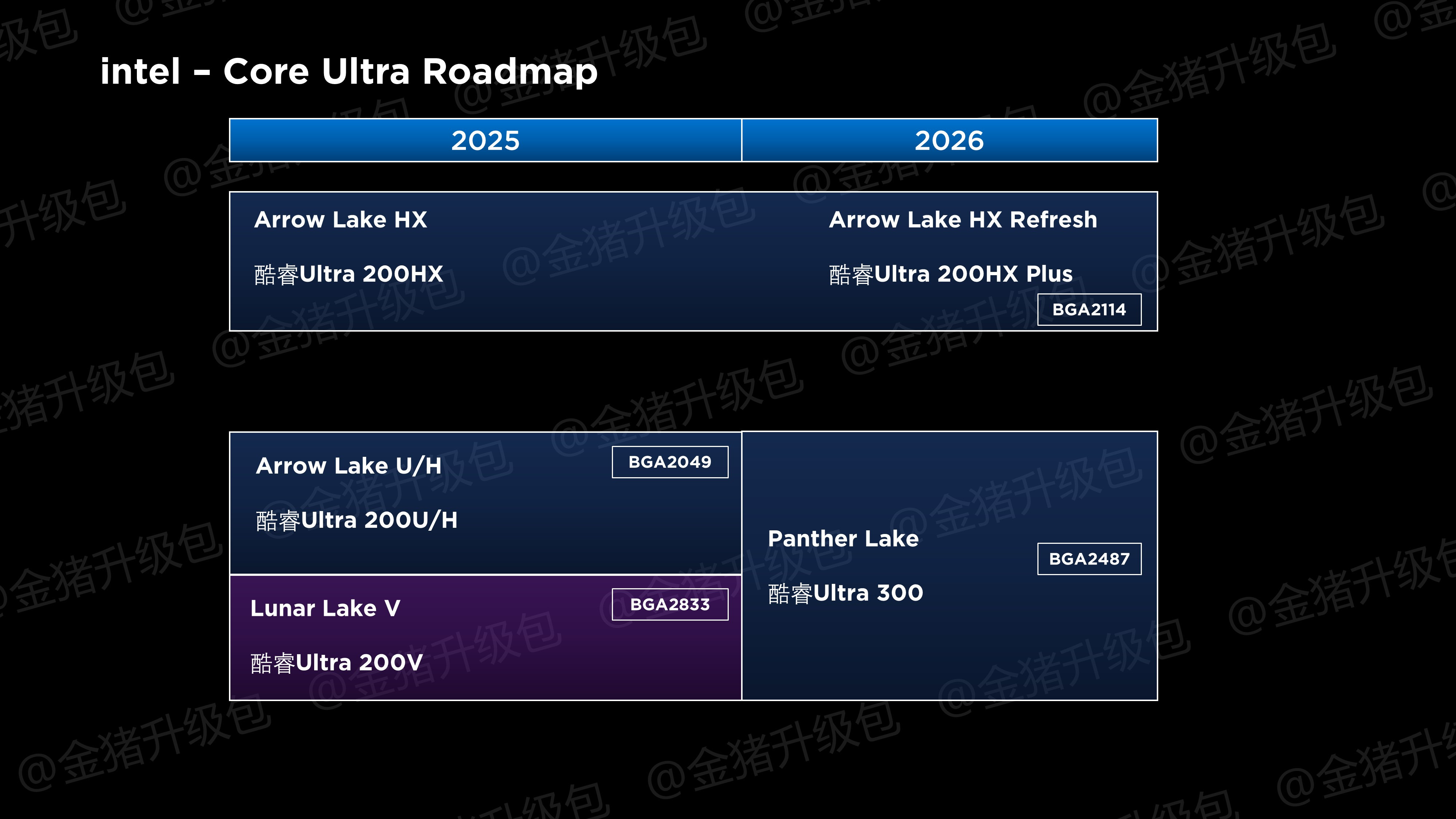
As for the high-performance segment, the current Arrow Lake Core Ultra 200 HX is scheduled for a refresh series in 2026. While it might be branded as the Core Ultra 200HX Plus, it will not adopt the Core Ultra 300HX moniker. The subsequent next-generation product, Nova Lake HX, is expected to cross directly to the Core Ultra 400HX name. In other words, the "Core Ultra 300HX" nomenclature is being skipped entirely.
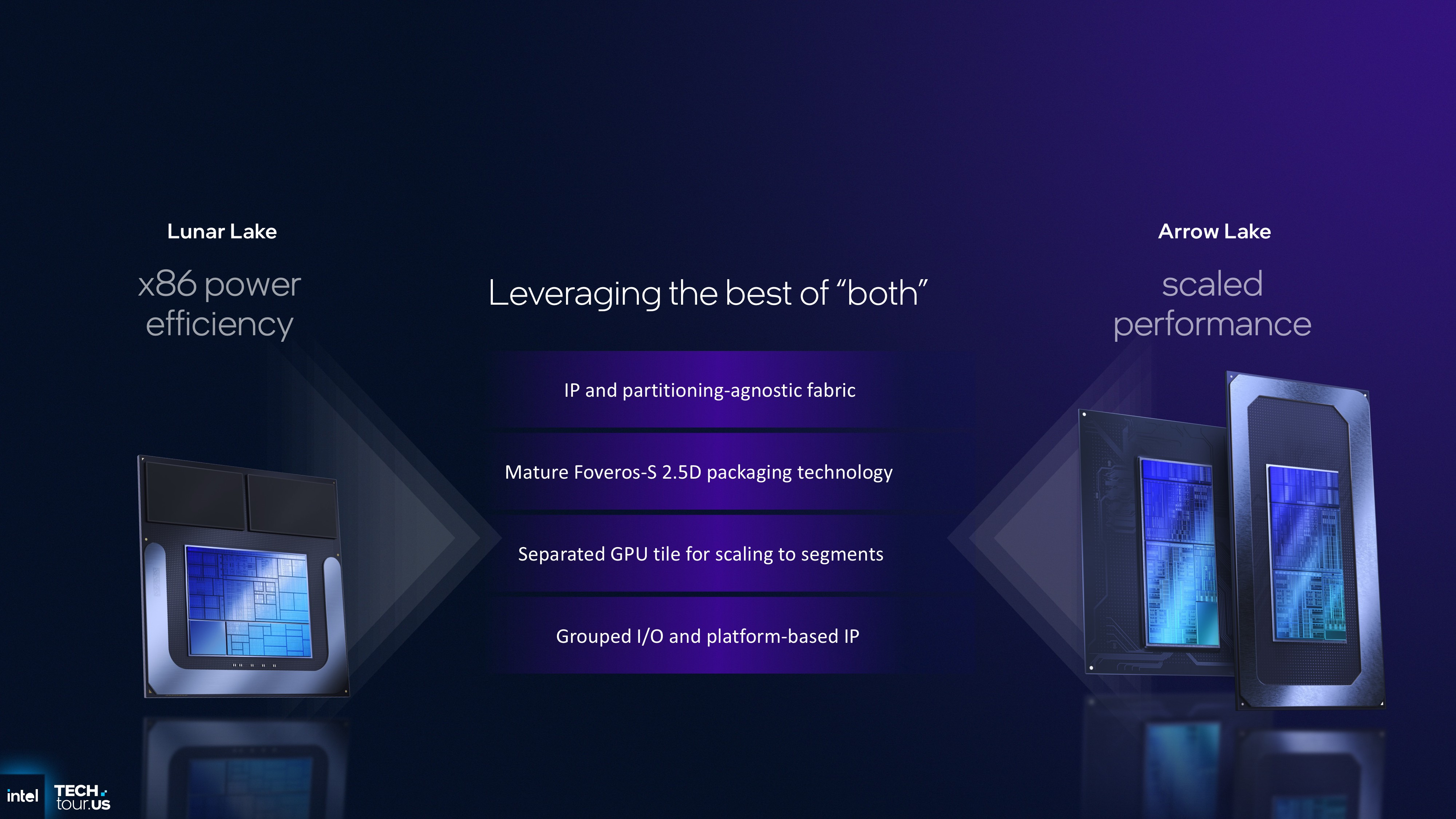
Intel claims they're combining the power efficiency of Lunar Lake with the scalable performance of Arrow Lake to strike a balance between power and efficiency. That's a really attractive pitch because it sounds like the best of both worlds.
Officially, Intel is positioning Panther Lake to completely replace the Arrow Lake-U/H and Lunar Lake-V lineups. However, when you look at market strategy and actual performance, calling it a "complete replacement" isn't entirely accurate—there are still a few niche areas where it’s not a 1-to-1 swap:
- Premium Positioning: Panther Lake is positioned as a higher-end product, meaning it comes with a steeper price tag.
- Low Power: Panther Lake can't fully replace the Lunar Lake 200V series in ultra-lightweight or extremely low-power devices, simply because Lunar Lake is much more focused on efficiency in those lower wattage ranges.
Architectural Evolution: From Four to Three, A Purer Tile Design
Panther Lake continues the multi-chip modular design we first saw with Meteor Lake, but it’s streamlining and consolidating the architecture to make things much more "pure".
Both Meteor Lake and Arrow Lake shared a similar four-Tile architecture, which looked something like this:
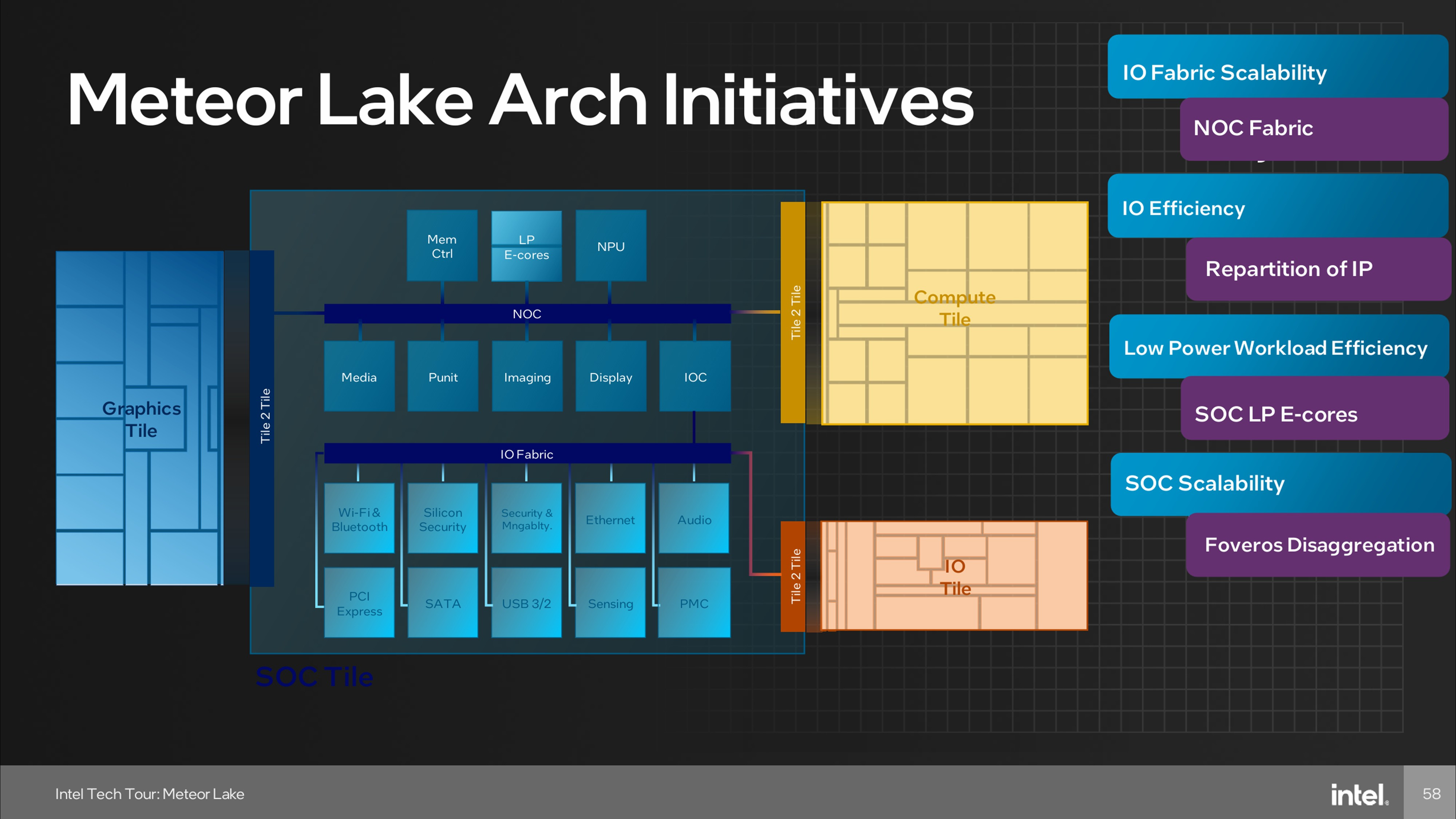
- CPU Tile: The main compute cores.
- GPU Tile: The integrated graphics.
- SoC Tile: The hub for the NPU, Media Engine, and other general components.
- IO Tile: Handles all your I/O interface expansion.
This design was a breakthrough for modular packaging, but the SoC Tile was doing a lot of heavy lifting. It was a bit complex—handling some compute units while also managing I/O—which meant the internal division of labor wasn't exactly clean or simple.
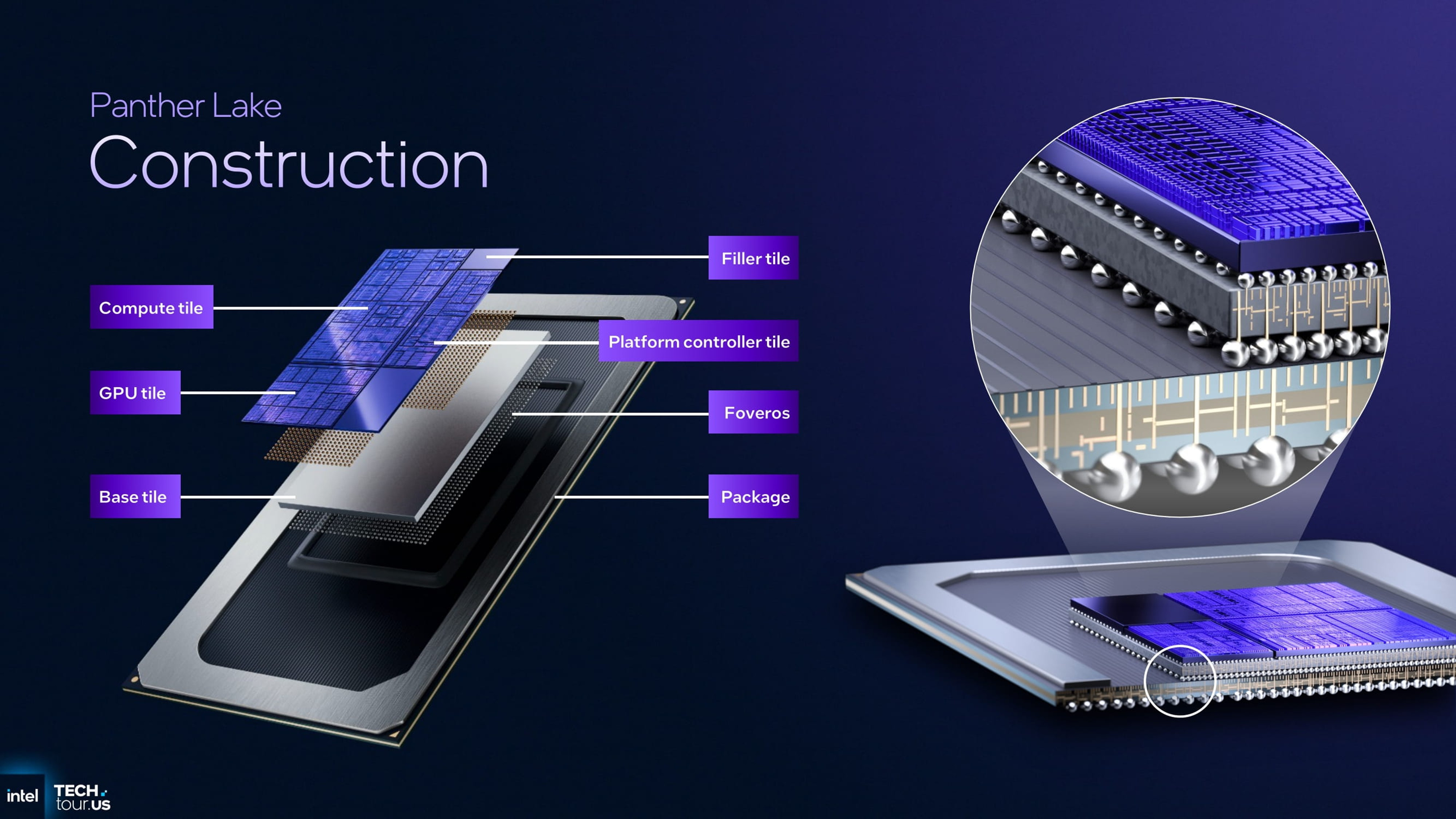
Panther Lake optimizes the previous 4-Tile structure into a streamlined design:
- Compute Tile: Integrates the CPU, NPU, Media Engine, and other primary compute and acceleration units.
- GPU Tile: Remains independent, facilitating the scaling of different tiers of integrated graphics.
- Platform Control Tile (PCT): Responsible for platform control, including I/O, Thunderbolt, USB, and PCIe.
This simplified three-Tile structure makes the chip hierarchy much clearer and allows for better planning across different SKUs (chip models) using shared packaging designs.
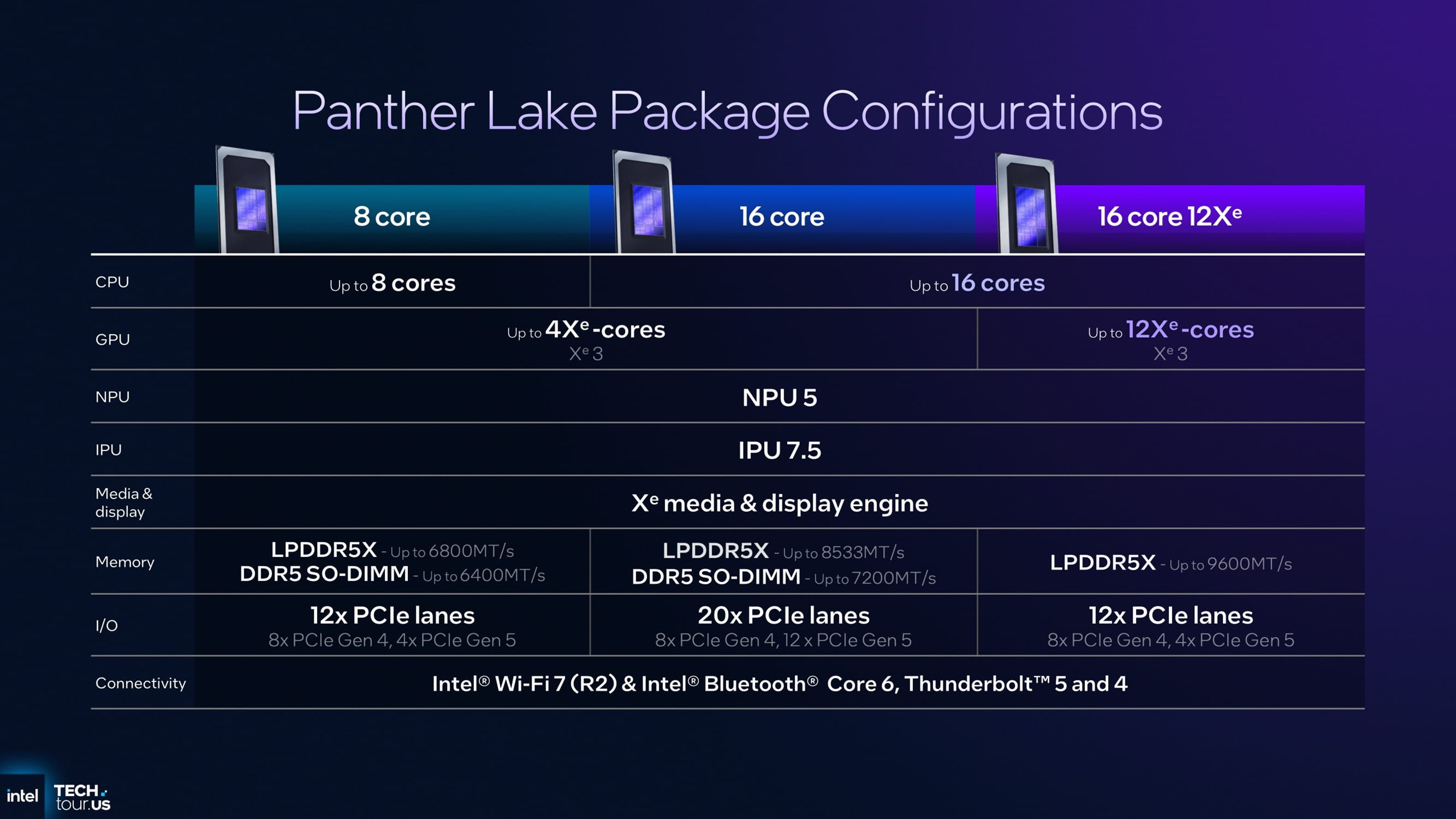
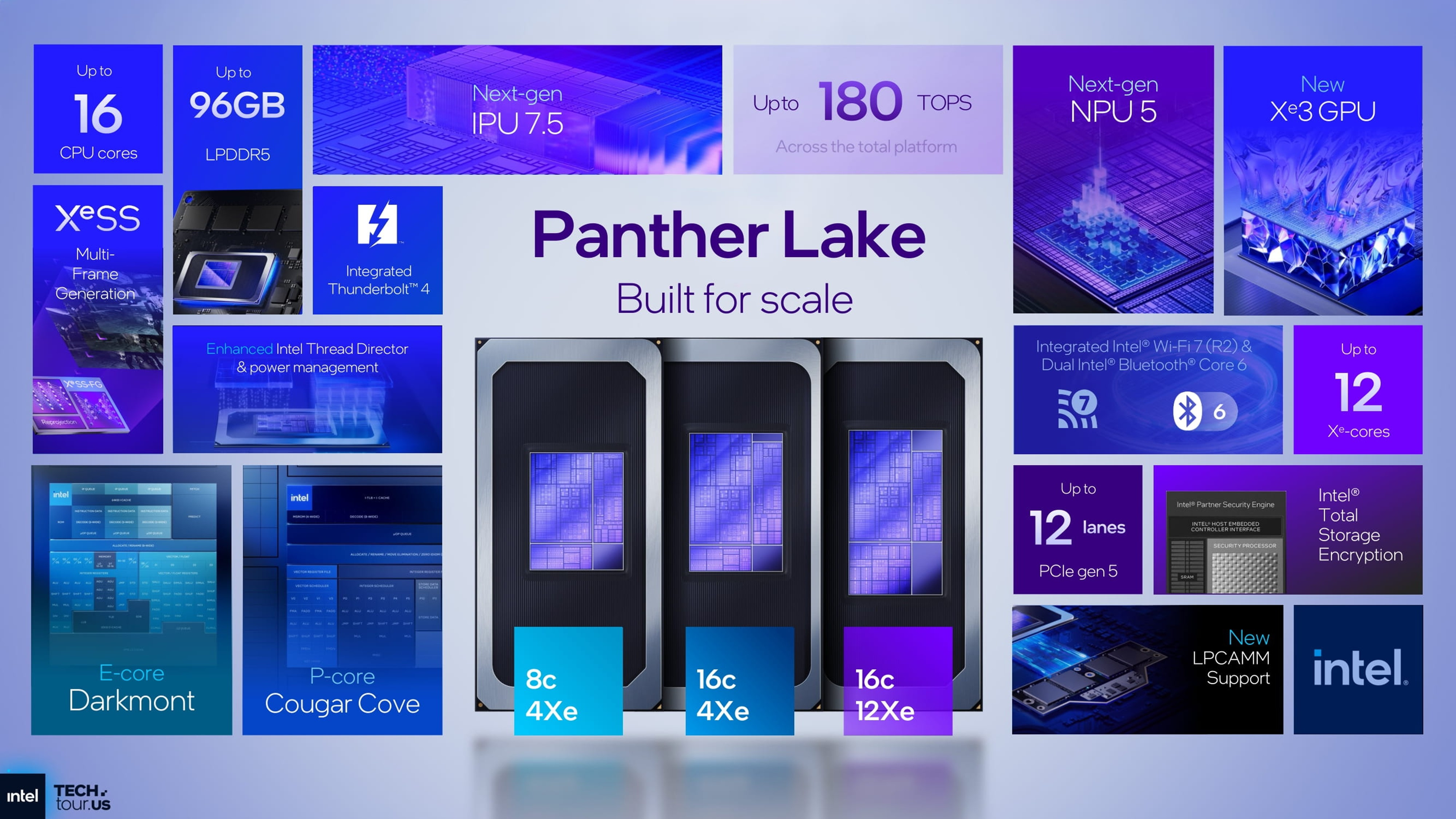
Intel specifically emphasized that Panther Lake achieves physical unification across models (Same Package Across All Designs). The three versions currently disclosed (the 8-core version, the 16-core version, and the 16-core + 12Xe graphics version) all benefit from this design.
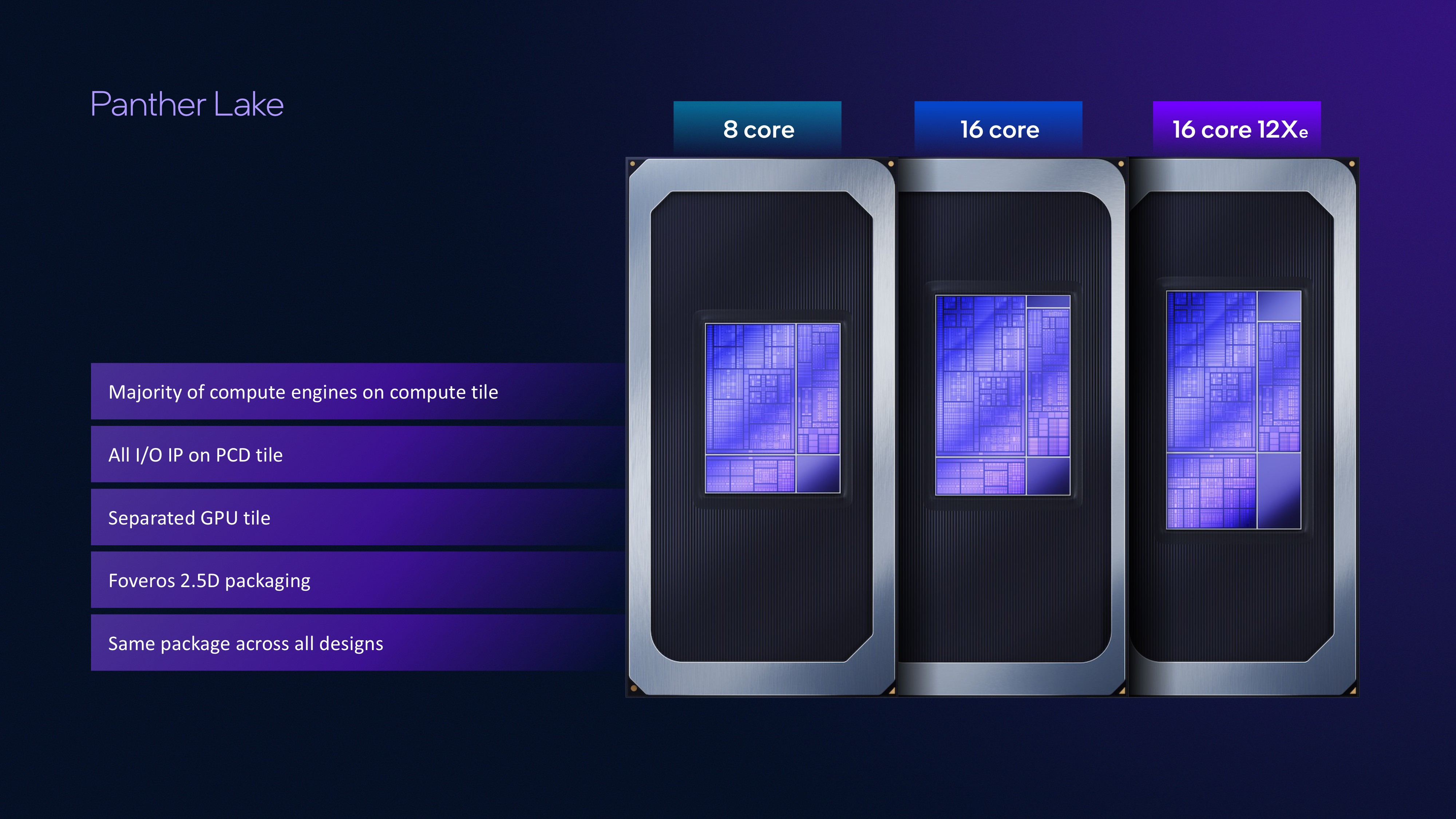
Whether it's the standard 8-core version, the high-performance 16-core version, or the 16-core version with powerful graphics, they can all be interchanged on the same motherboard.
Original Equipment Manufacturers (OEMs) can validate different configurations using the same chassis/mold, thereby significantly reducing development and validation costs.
This "Pin-to-Pin compatibility" enhances the flexibility of the entire platform. However, there are still detailed limitations regarding electrical design and power control, so complete interchangeability will ultimately depend on the specific laptop or device model.
Introduction to Three Specifications
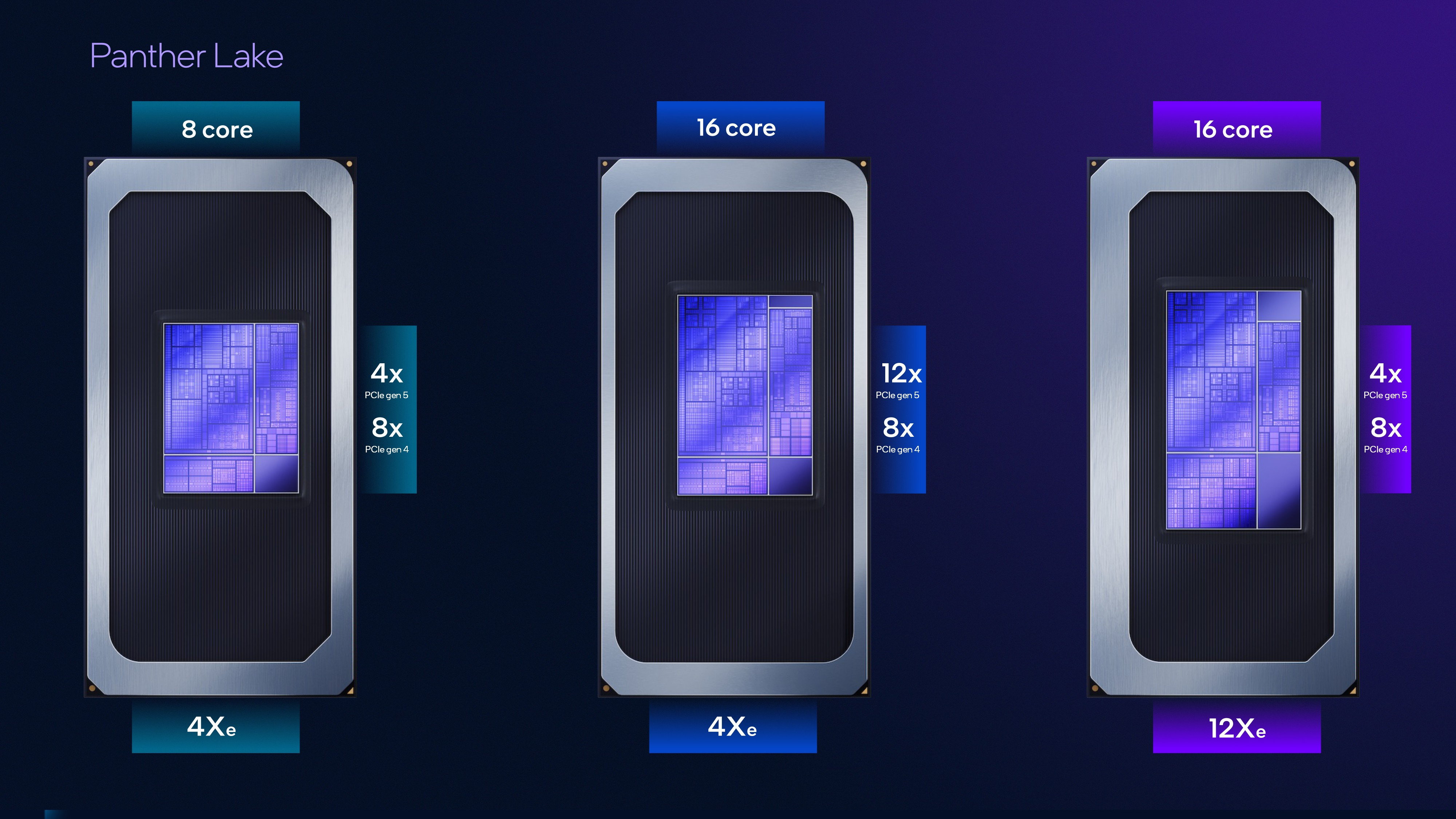
The Panther Lake series continues a tiered layout ranging from energy efficiency to high performance, divided into three core configurations:
Shared Platform Baseline (from the translator Vitamin P)
Before diving into each SKU, it’s worth outlining what the Panther Lake mobile platform has in common across the lineup:
- Three‑tile design for all SKUs:
- Compute Tile on Intel 18A (CPU + NPU + Media Engine)
- GPU Tile on Intel 3 or TSMC N3E depending on iGPU scale
- Platform Control Tile (PCT) on TSMC N6 for I/O and connectivity
- Memory Side Cache retained across the family to relieve DRAM pressure and improve effective bandwidth, especially under light to medium loads.
- DLVR (Digital Linear Voltage Regulator) power-delivery architecture instead of Lunar Lake’s fully integrated PMIC solution, favoring cost-control and easier reuse of existing board designs.
Each SKU then tweaks cores, iGPU size, memory options, and PCIe lane counts on top of this common foundation to target different devices and price points.
If you just want a quick takeaway without diving into every architectural detail, here’s how the three main Panther Lake mobile SKUs compare and which type of laptop each one is really built for:
| SKU (nickname) | PTL 404 | PTL 484 (4Xe) | PTL 484 (12Xe) |
|---|---|---|---|
| Positioning | Entry‑Level: Thin‑and‑Light | Mid‑Range: Gaming / Performance | High‑End: iGPU Ultra Performance |
| CPU Layout | 8 Cores: 4P + 0E + 4 LP E‑cores | 16 Cores: 4P + 8E + 4 LP E‑cores | 16 Cores: 4P + 8E + 4 LP E‑cores |
| iGPU & Memory | Xe3 · 4 Xe cores · LPDDR5X‑6800 / DDR5‑6400 | Xe3 · 4 Xe cores · DDR5‑7200 via CSODIMM | Xe3 · 12 Xe cores · LPDDR5X‑only up to 9600 MT/s |
| PCIe Lanes & Expansion | 12 lanes total · Enough for basic SSD + I/O | 20 lanes total · Typical split: 8 dGPU + 8 SSD + 4 GPP | 12 lanes total · Very limited headroom beyond SSDs and basic I/O |
| Best For | Mainstream office / student laptops · Thin‑and‑light productivity · “Better than U‑series” everyday machines | Thin‑and‑light gaming laptops · Creator / performance notebooks with dGPU | Premium ultraportables · AI / GPU‑accelerated productivity · dGPU‑less “all‑in‑one” thin‑and‑light machines |
| Key Trade‑Offs | Strong efficiency at light / medium loads, but limited GPU and lane budget. Not ideal for heavy gaming or large PCIe expansions. | Gaming laptop with PCIe 20‑lane budget is enough but not luxurious; iGPU is minimal (display‑first), a discrete GPU for serious gaming required | Huge integrated GPU bandwidth and compute, but no real space for dGPU and tight PCIe budget. Great all‑in‑one graphics, less ideal for heavy external expansion. |
Entry-Level: 8 Cores + Standard Integrated Graphics
4P+4E, 4Xe iGPU. It is targeted at ultra-thin laptops with extremely low power consumption; lower cost. Some models serve as derivative alternatives to Lunar Lake-V.
Mid-Range: 16 Cores + Standard Integrated Graphics
4P+8E+4LPE, 4Xe iGPU. It is aimed at gaming laptops or high‑performance thin‑and‑light laptops, and is designed to be paired with discrete graphics cards, offering more flexible PCIe lane allocation.
High-End: 16 Cores + High-Performance Integrated Graphics
4P+8E+4LPE, 12Xe iGPU. This SKU features a GPU Tile with the high‑performance integrated graphics configuration, and is suitable for premium thin‑and‑light products that do not rely on discrete graphics.
These three core specifications cover everything from ultra-low power products to those demanding high GPU performance and expandability.
It is worth noting that the Panther Lake series also marks a significant shift in how these CPUs are described and promoted. Intel no longer emphasizes the distinction between the number of P-cores (Performance cores) and E-cores (Efficient cores) as heavily as before. Instead, they are adopting a simpler designation based on the total core count. For example, an "8-core processor" will simply be referred to as "8-core," without specifying if it is "4P+4E" or "6P+2E".
PTL404 is simply called an “8‑core” chip, and PTL484 is a “16‑core” chip , but the ratio of performance cores to efficiency cores is no longer disclosed in details in advertising and marketing.
This approach aligns closer to AMD's naming strategy. AMD has long used "total core count" for naming; for instance, their 8-core CPUs might also be a 4+4 hybrid design of homogeneous cores, yet the market and users generally do not scrutinize the internal structure. From a marketing perspective, Intel's move makes it easier for consumers to understand and avoids the cognitive burden brought by technical terms like "P-core" and "E-core."
Entry-Level: 8 Cores + 4Xe iGPU (PTL 404)
First up, let's take a look at the entry‑level CPU: the 8‑core + 4Xe variant we’ll refer to as PTL 404 (4P + 0E + 4 LP E‑cores).
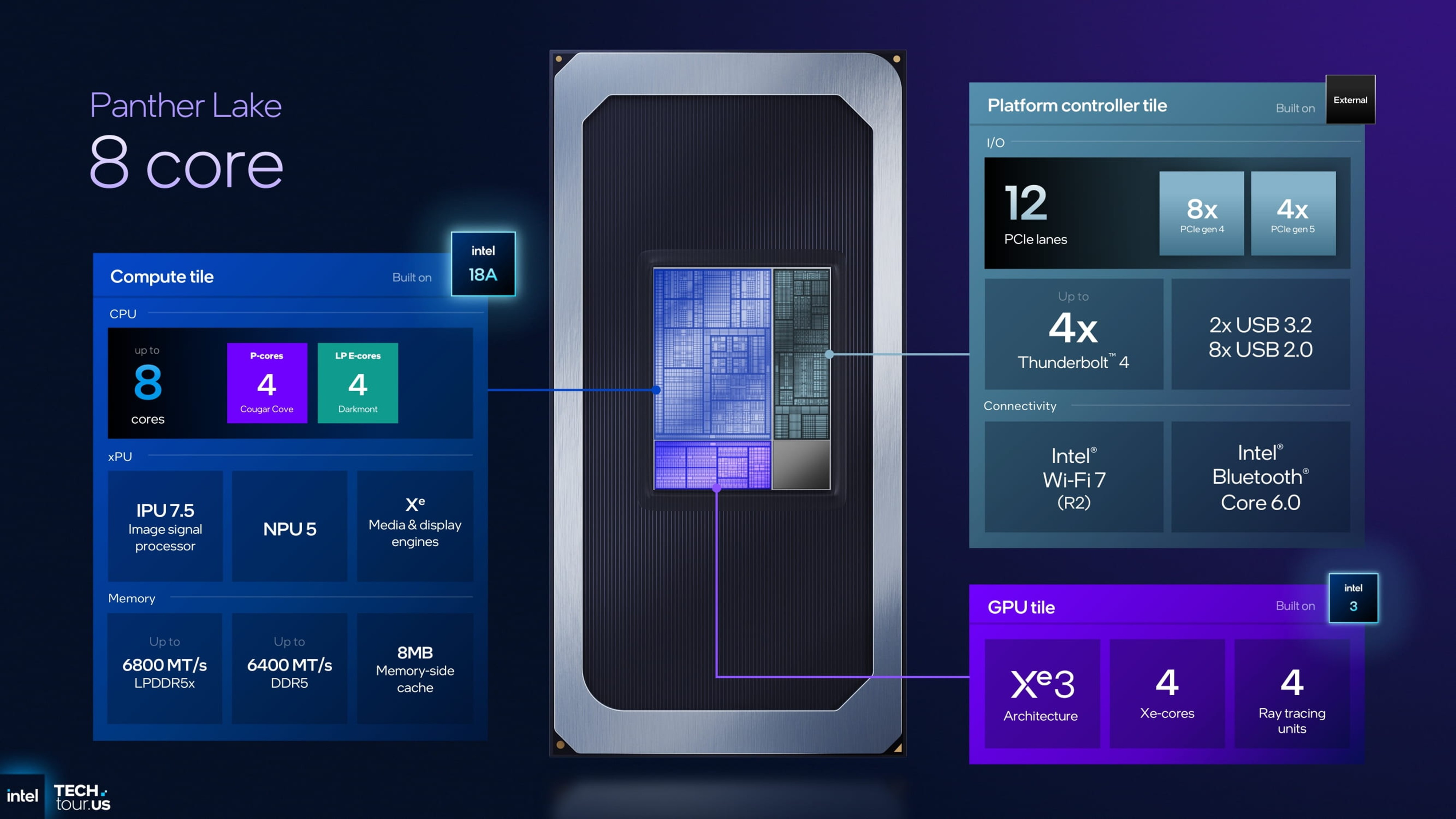
The design philosophy behind this specific Panther Lake model is actually very close to Lunar Lake’s. It uses a combination of 4 Performance Cores (P‑cores) paired with 4 Low‑Power Efficiency Cores (LP E‑cores).
These LP E‑cores are situated on a dedicated “Low‑Power Island,” meaning they don't share the same ring bus as the performance cores. Architecturally, this allows the LP E-cores to run independently during light workloads, which is huge for driving down overall power consumption.
On the memory front, this version supports up to LPDDR5X-6800 and DDR5-6400 . It also retains the 8MB Memory Side Cache. This is a mechanism we saw in Lunar Lake, designed to reduce memory pressure and boost data access efficiency when bandwidth is tight. Overall, Panther Lake’s CPU architecture feels very similar to Lunar Lake’s, especially in how it carries over those lessons in power efficiency and cache design.
For graphics, we’re seeing an upgrade to the Xe3 architecture — Intel’s next‑gen integrated GPU tech.
However, this specific SKU only comes with 4 Xe cores , which is effectively half the scale of what we got in Lunar Lake. So this model feels more like a direct successor to Arrow Lake-U rather than a full-on replacement for Lunar Lake's higher-end SKUs.
This multi‑node packaging continues Intel’s modular strategy of trying to find that sweet spot among performance, cost, and efficiency.
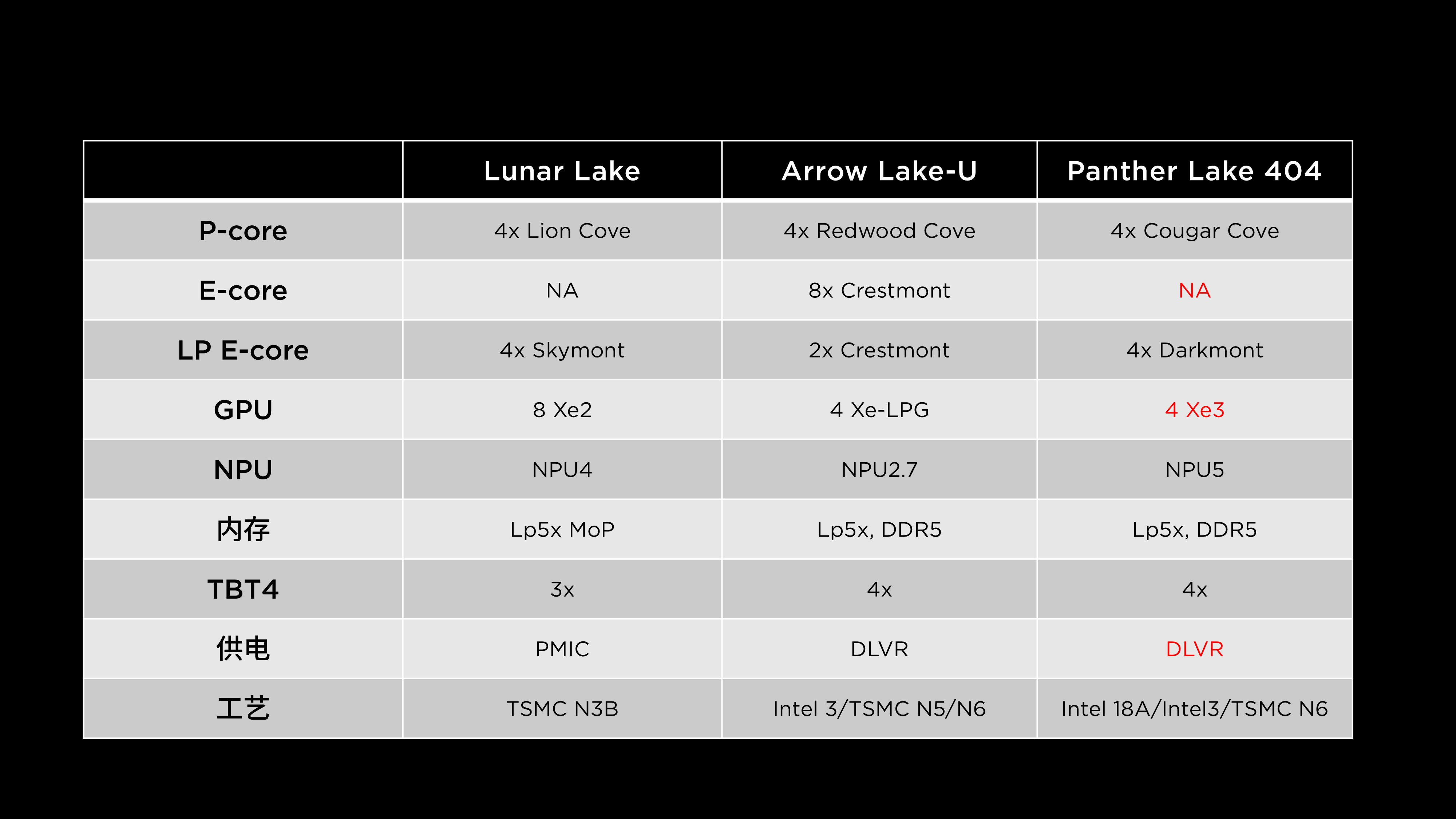
Compared to Arrow Lake‑U, the Panther Lake PTL 404 ditches the traditional E‑core design. And compared to Lunar Lake, it scales back the iGPU a bit. It supports both LPDDR5X and standard DDR5, but it does not support Memory on Package (MOP) . While this doesn't have a massive impact on power draw, it does give OEMs a lot more flexibility with motherboard layouts.
Thunderbolt support and the DLVR power-delivery architecture are in line with the broader Panther Lake platform. With its lightweight Xe3 iGPU and balanced CPU configuration, PTL 404 clearly targets mainstream thin‑and‑light productivity laptops, focusing on office workloads and high efficiency rather than raw GPU or CPU throughput.
Mid-Range: 16 Cores + 4Xe iGPU (PTL 484)
Panther Lake also includes a stronger core variant aimed squarely at higher‑performance notebooks that may rely on a discrete GPU.
Compared with the entry‑level PTL 404, this mid‑range SKU adds 8 Efficiency Cores (E‑cores) to create a 4P + 8E + 4 LP E‑core layout with the same 4‑core Xe3 iGPU — what we call PTL 484 here. Some people were holding out hope for a 6 P-core version, but that didn't happen. Intel has settled on this 4+8+4 design as the final answer.
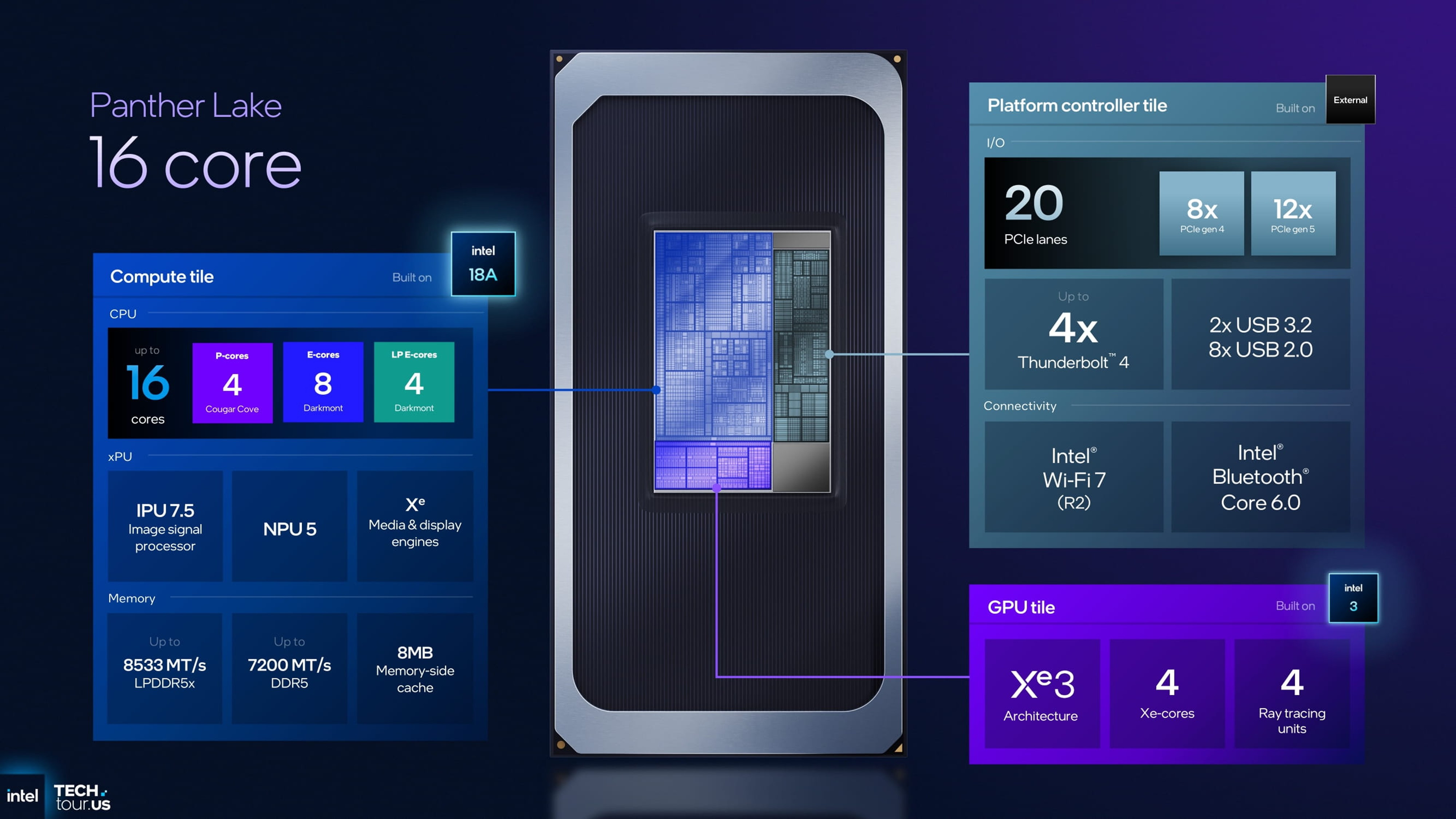
The PTL 484 takes memory to the next level, supporting up to DDR5-7200 at native JEDEC frequencies. That is currently the highest native frequency supported on any laptop platform. To support such frequencies, this version uses CSODIMM (Compact SO‑DIMM) modules and integrates a CKD redriver to handle timing compensation and signal integrity at those high speeds.
To accommodate discrete graphics, the Platform Control Die (PCD) adds 8 PCIe 5.0 lanes , bringing the system total to 20 PCIe lanes . The integrated graphics side sticks with that same 4-core Xe3 GPU we saw in the 8-core version.
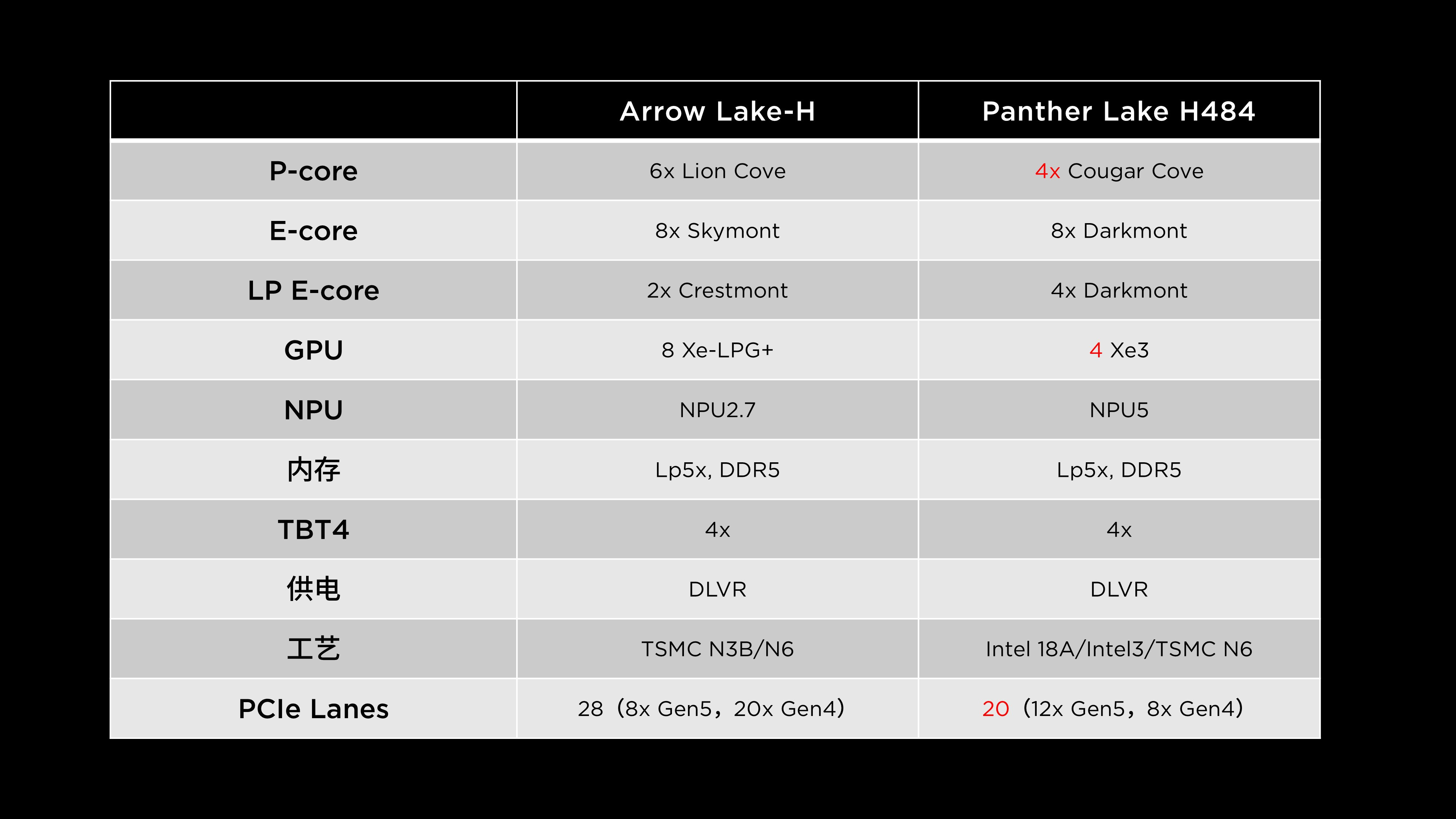
Compared to the previous Arrow Lake platform, the main changes here are in core counts and I/O specs. With only 4 P‑cores , this SKU aligns more with the previous Ultra 5 tier and is actually down two P‑cores compared to the 6 P‑cores in the Ultra 7 200H. Intel’s new generation of energy‑efficient cores is not weak either, unlike the first generation, which had a significant performance gap between P‑cores and E‑cores.
But why the cut? Why PCIe lane cuts?
Arrow Lake‑H’s 28 lanes were arguably “luxurious” for thin‑and‑light gaming machines, adding cost and complexity that many designs didn’t fully use. The new 20‑lane configuration is closer to what AMD offers and represents a more balanced trade‑off between expandability, power, and BOM cost.
Here is how OEMs will typically allocate those lanes:
- 8 lanes for the discrete GPU.
- 8 lanes split between two storage drives.
- The remaining 4 lanes serve as a General Purpose Port (GPP) for peripherals like network cards or card readers.
Keeping the iGPU at just 4 Xe cores may be a cost-saving measure. Unlike the top-tier Arrow Lake-H series, this mid-range version is expected to be paired with high-power discrete GPUs anyway, so a smaller iGPU is perfectly sufficient for handling basic display output.
On the AI front, the NPU gets a massive upgrade from NPU 2.7 to NPU 5 . This brings full support for the new Copilot+ PC standards, capable of running various AI assistant features like "Recall."
This design balances expandability with power consumption and motherboard complexity. But let's be real—the core reason is cost control, making this the standard configuration for mid-to-high-end thin gaming laptops in the Panther Lake era.
High-End: 16 Cores + 12Xe iGPU (PTL 484)
This spec represents the absolute top tier of the Panther Lake lineup.
On the CPU side, the configuration is identical to the mid‑range version:4 Performance Cores (P‑cores), 8 Efficiency Cores (E‑cores), and 4 Low‑Power E‑cores (LP E‑cores).
The real differentiation is entirely in the graphics and memory subsystems.
Because this model is packing a significantly larger integrated GPU, Intel makes specific adjustments to the memory specifications and process design to support better GPU performance.
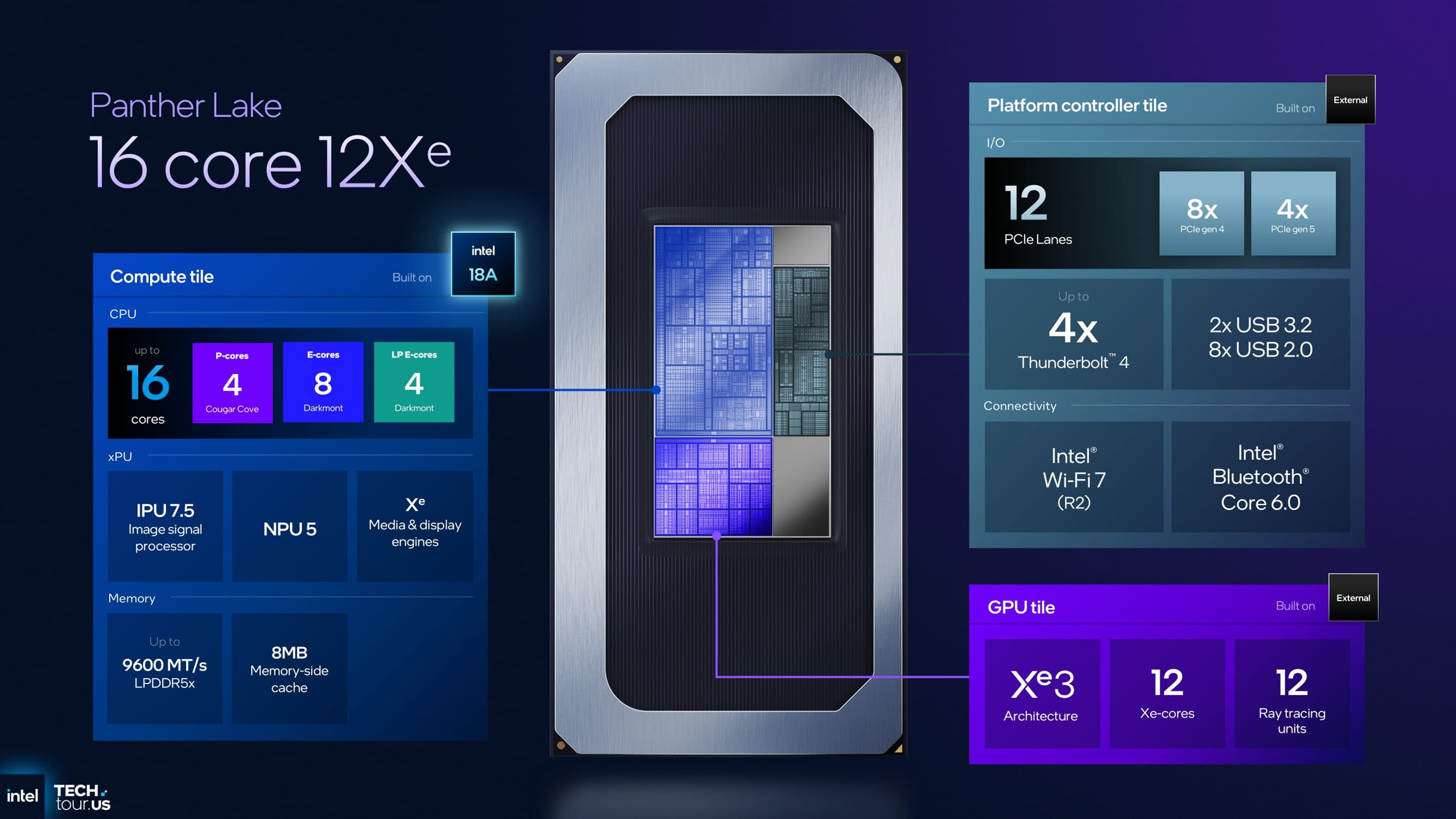
In its high‑end configuration, PTL 484 + 12Xe only supports LPDDR5X memory and no longer works with regular DDR5.This design choice is all about bandwidth: a more powerful integrated GPU needs a much faster memory subsystem. LPDDR5X now goes up to 9600 MT/s , making it the highest native memory speed supported by any integrated‑GPU laptop platform as of Q4 2025.
As for the GPU Tile used in the PTL 484 + 12Xe high‑end setup, using Intel’s own Intel 3 process for a GPU of this scale would likely be too costly, given the required density. So Intel outsources it to TSMC, using the TSMC N3E process node. Compared to the N3B node used in Lunar Lake, N3E is more mature and more cost‑effective. Qualcomm’s Snapdragon 8 Elite also uses N3E for the same reason — better cost efficiency. Intel’s goal here is clear: reduce manufacturing costs, improve scalability and module reuse.
That said, even with these “cost optimizations,” the GPU Tile is so much larger now that overall manufacturing cost is still quite high. When Intel says “cost‑down,” it doesn’t mean it is making a cheap part. It simply means they’re trying to keep expenses under control through modular reuse so the product remains commercially viable, rather than hitting some kind of low‑cost price point.
The PTL 484 + 12Xe high‑end spec still comes with 12 PCIe lanes , the same as the 8‑core PTL 404. There’s no additional expansion specifically for discrete GPUs. This pretty much confirms that the high‑end Panther Lake lineup is designed with integrated graphics as the primary display engine , without putting much emphasis on pairing it with a dedicated GPU.
Compared with last year’s Arrow Lake platform, the Panther Lake High‑End lineup has some obvious traits:
- Not many performance cores, but a huge improvement in integrated GPU performance
- NPU upgraded to NPU 5 for stronger AI processing
- LPDDR5X‑only , with DDR5 support fully removed
- Same DLVR power regulation architecture as before
- PCIe lanes reduced to 12 , which limits certain high‑bandwidth expansion options
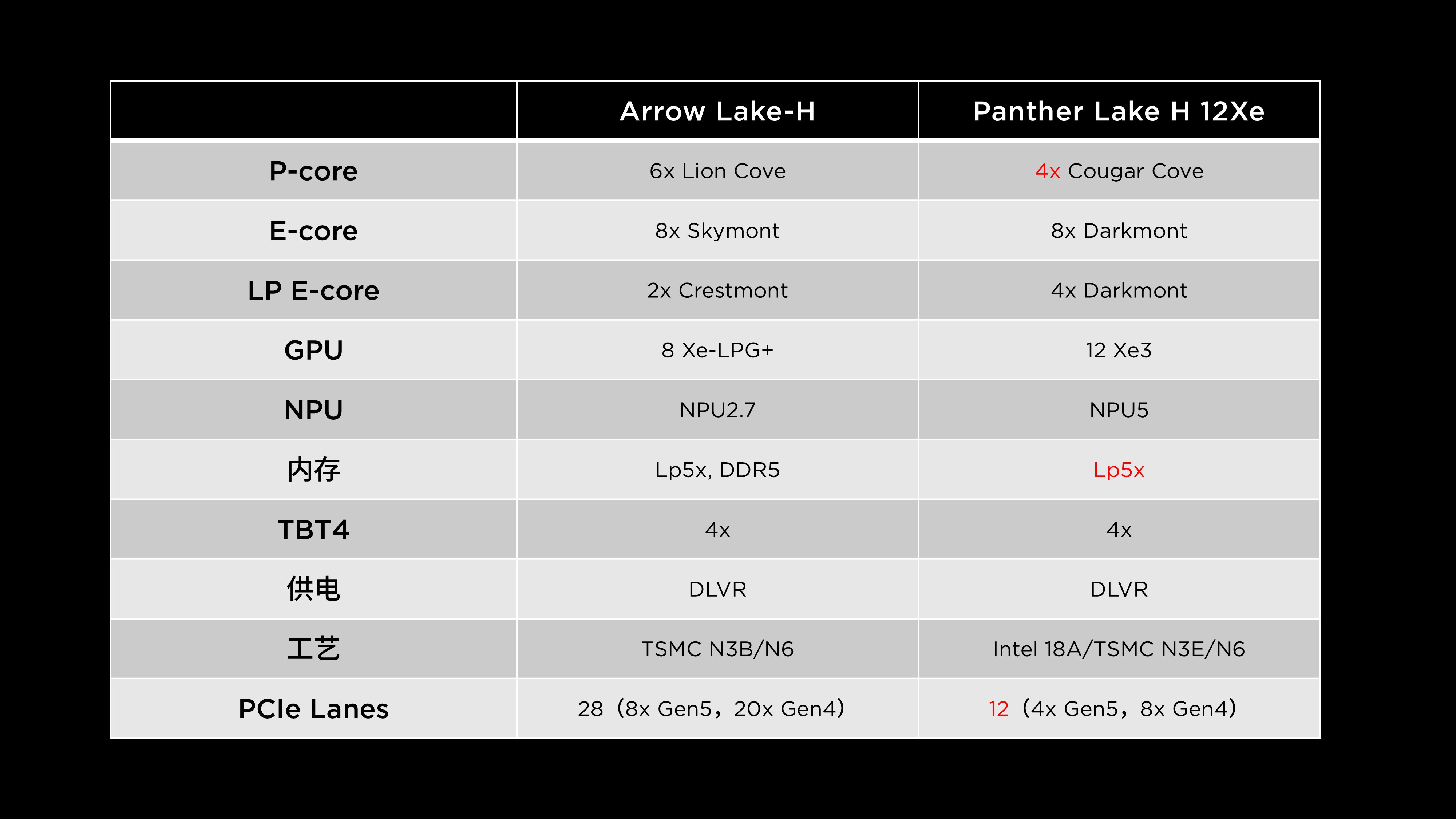
From a practical standpoint, with this lane configuration, if a laptop motherboard includes two M.2 NVMe slots (using 8 PCIe lanes total), that leaves only 4 lanes for everything else. This means features like an OCuLink external GPU port could easily run into lane‑budget issues.
Designers now have to make trade‑offs among peripherals such as:
- Wired Ethernet (RJ45)
- Wireless card (CNVi interface)
- Card readers and other accessory modules
For example, a laptop might drop the RJ45 Ethernet jack, rely solely on a CNVi wireless solution, and route the card reader through USB. That way the system can stay feature‑complete while staying within the tight PCIe lane budget.
Overall, the high‑end version focuses on high integration and strong on‑die GPU compute capability.
Without needing a discrete GPU, it aims to give high‑end ultraportables graphics and AI performance close to that of mid‑range dedicated GPUs. This makes the Panther Lake lineup well‑tiered for thin‑and‑light laptops, high‑efficiency notebooks, and AI‑focused machines.
And with that, we’ve basically covered Intel’s entire Panther Lake family. One thing you’ll notice is that Intel is no longer advertising specific core types or how they’re split. They’re using total core count as the only label.
PTL404 is simply called an “8‑core” chip, and PTL484 is a “16‑core” chip , but the ratio of performance cores to efficiency cores is no longer disclosed.
CPU Performance
Based on what we know so far, Panther Lake’s CPU performance gains are fairly modest — nowhere near the big jump many people were expecting. Intel has focused more on power efficiency this generation, while raw performance uplift isn’t particularly dramatic.
In Intel’s official data, Panther Lake’s single‑core comparison isn’t made against Arrow Lake, but against Lunar Lake . Compared to Lunar Lake, it delivers around a 10% increase in single‑core performance . The comparison chips shown in the chart are the Core Ultra 9 285H and the Core Ultra 9 288V.
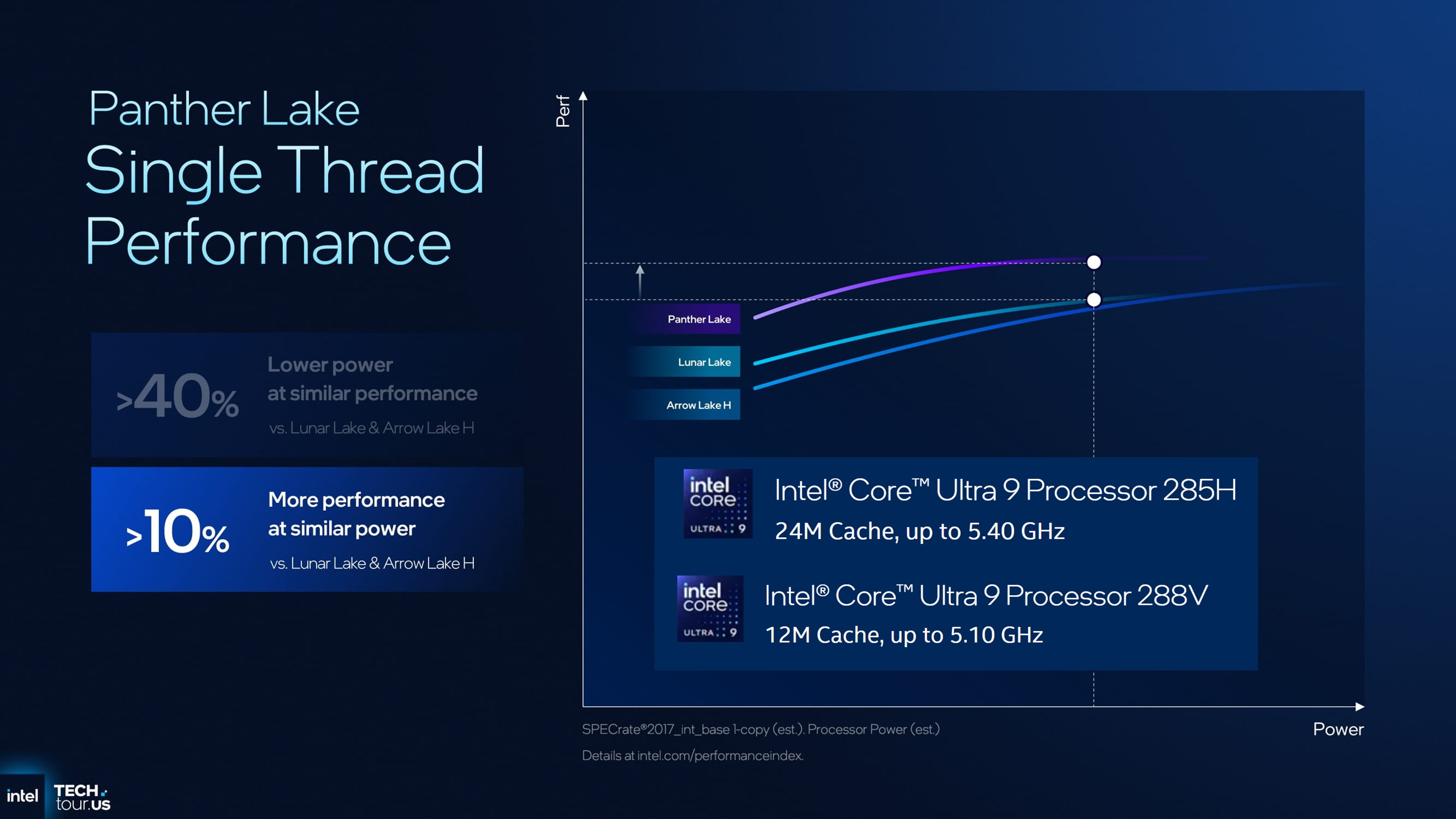
Looking at the performance curve, Lunar Lake is already flattening out near its peak, Arrow Lake still has some headroom, and Panther Lake sits on a relatively stable trajectory. Since the frequency gap between high‑end Lunar Lake and Arrow Lake models alone accounts for about a 6% performance difference, the real‑world takeaway is that Panther Lake’s single‑core improvement over Arrow Lake H is only about 5%–6% , basically a single‑digit bump.
One important change this generation is that LP E‑cores can now participate in foreground tasks , which is completely different from before. Because of that, multi‑thread performance sees a noticeable improvement compared to previous generations.
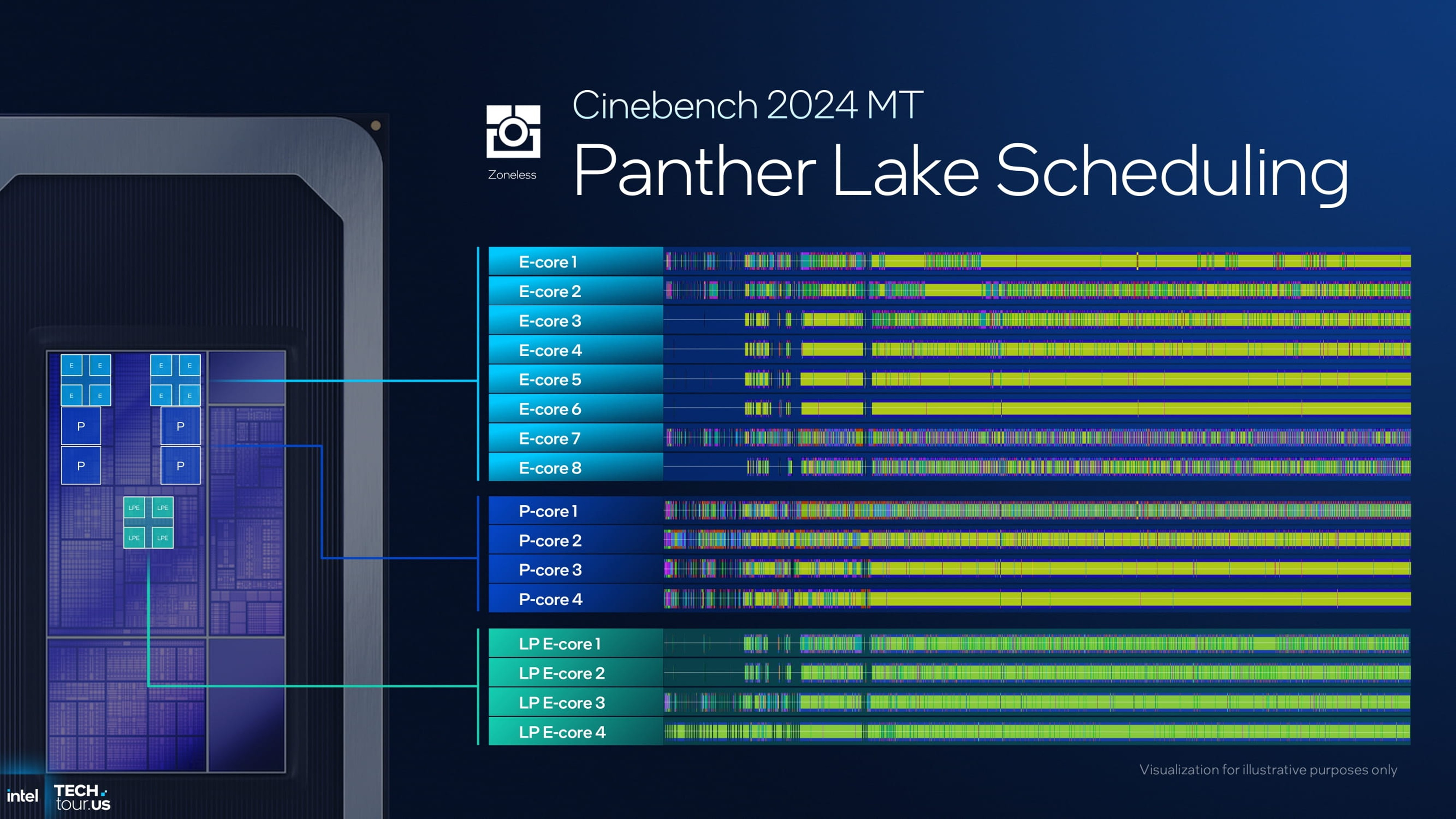
(Note: more details about thread scheduling in the session "Power Efficiency Design for Panther Lake")
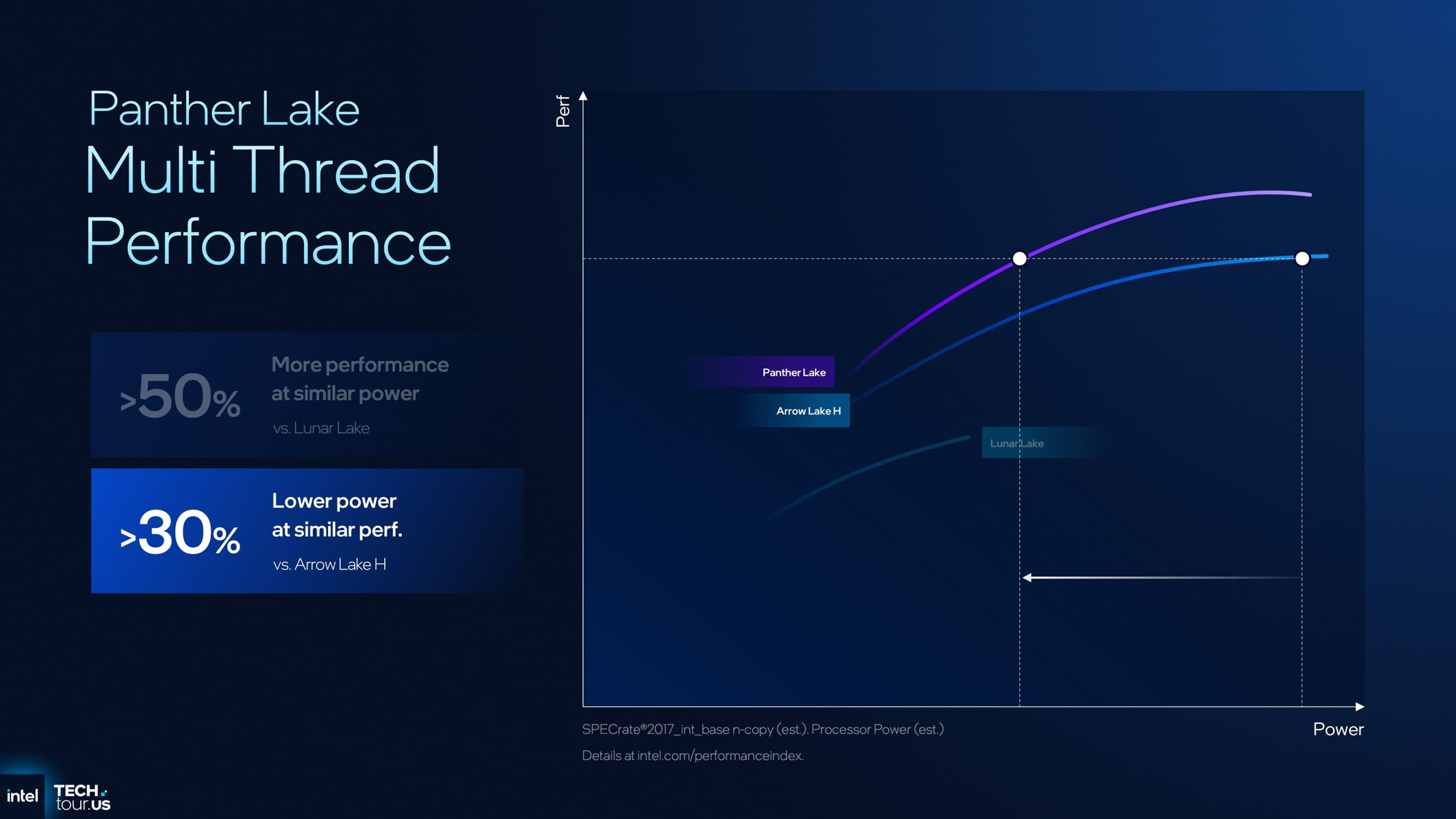
Even though Panther Lake looks good on multi‑core charts, Intel still avoids putting it head‑to‑head against Arrow Lake. The gains they highlight are mostly versus Lunar Lake at the same power level: around 50% higher multi‑core performance . Most of that improvement comes from having more cores and a more advanced manufacturing process.
When compared with Arrow Lake, Intel instead emphasizes that power consumption drops by about 30% at the same performance level . So overall, you shouldn’t expect major single‑core or multi‑core breakthroughs from Panther Lake. Its real strength is power efficiency , not raw CPU performance.
GPU Performance
Unlike the relatively mild CPU improvements, the integrated GPU is the biggest highlight of Panther Lake . Intel is extremely confident in its 12‑Xe, Xe3‑architecture iGPU—both the internal charts and comparison data show a major jump in performance.
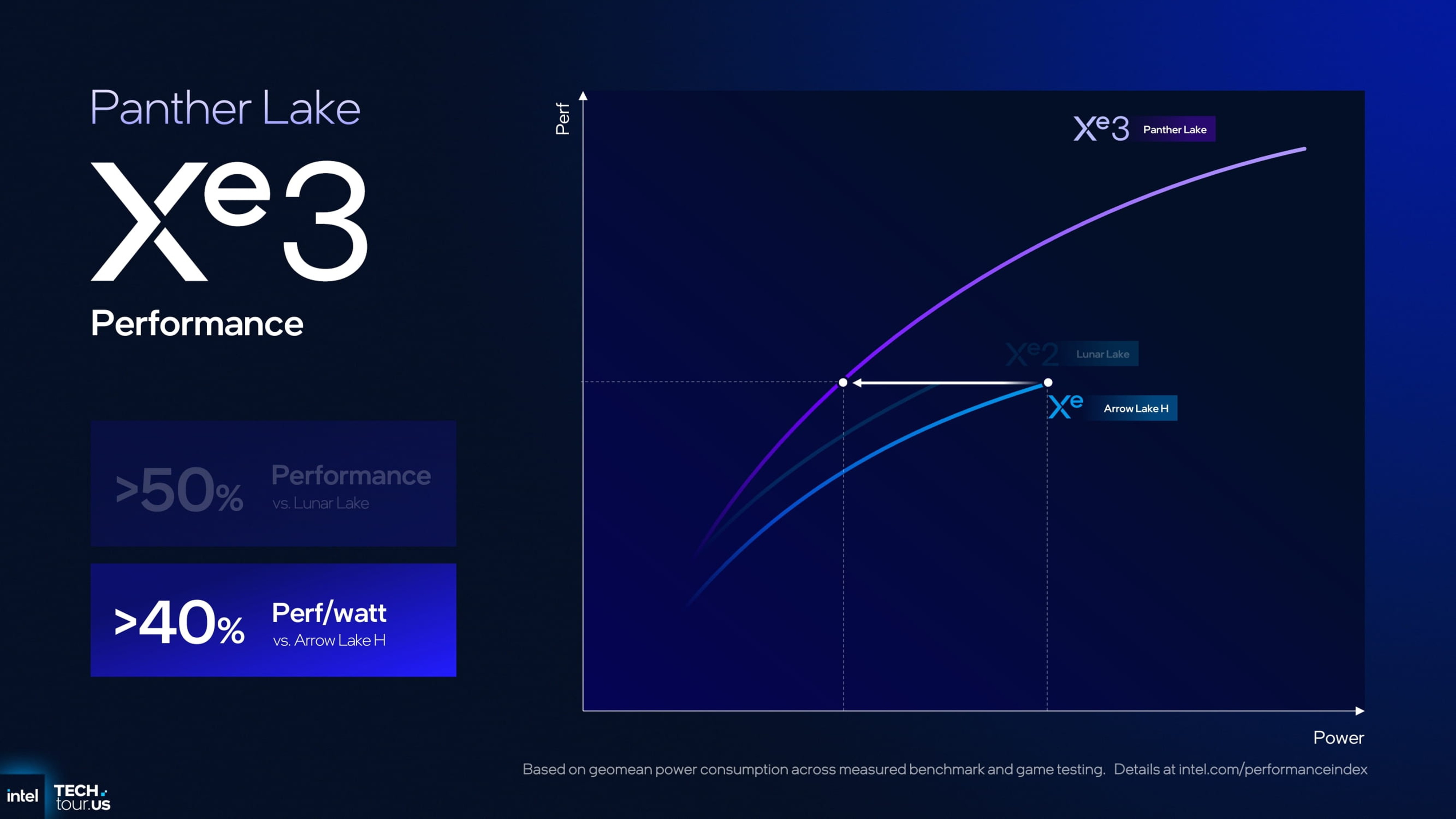
The new 12‑Xe (Xe3) iGPU delivers over 50% higher performance compared with Lunar Lake’s integrated graphics, based on pure, unrestricted performance comparisons. Using today’s common GPU benchmark - 3DMark Time Spy, Lunar Lake’s 8-Xe(Xe2) iGPU scores around 4000 points, while the new 12‑Xe configuration in Panther Lake is theoretically capable of reaching the 6000‑point range.
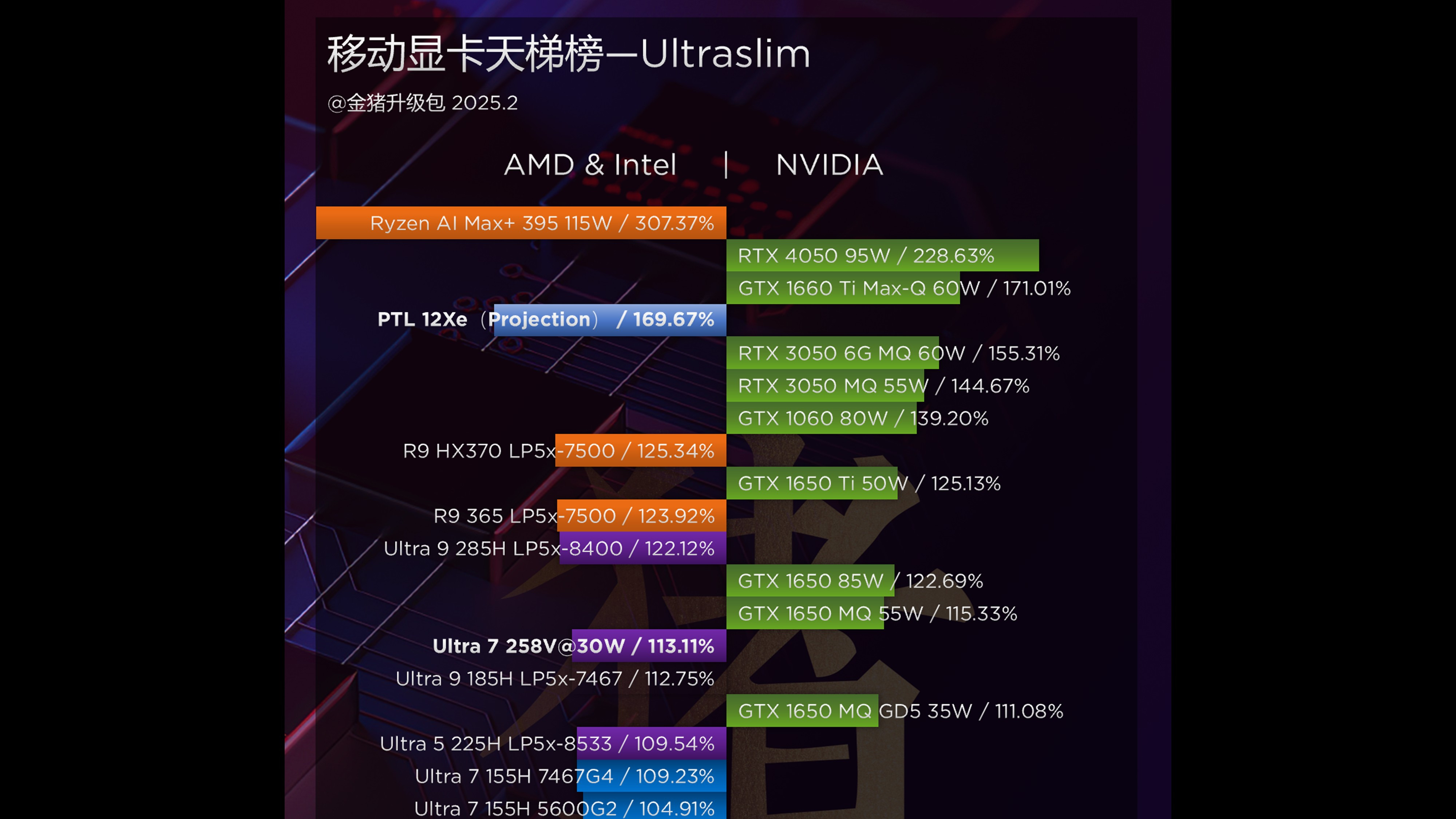
Using discrete‑GPU performance as a reference, a 6000‑point Time Spy score puts it right around the level of an NVIDIA GeForce RTX 3050 Laptop GPU , and even edging close to the GTX 1660 Ti Max‑Q range. If Intel’s numbers are accurate, Panther Lake’s integrated graphics would rank among the strongest dual‑channel iGPUs in the entire industry right now.
Panther Lake’s iGPU also fully supports Intel XeSS 3.0 and adds MFG (multi-frame generation) . This means that in supported games or apps, the GPU can use AI‑based frame interpolation to significantly boost frame rates and overall smoothness.
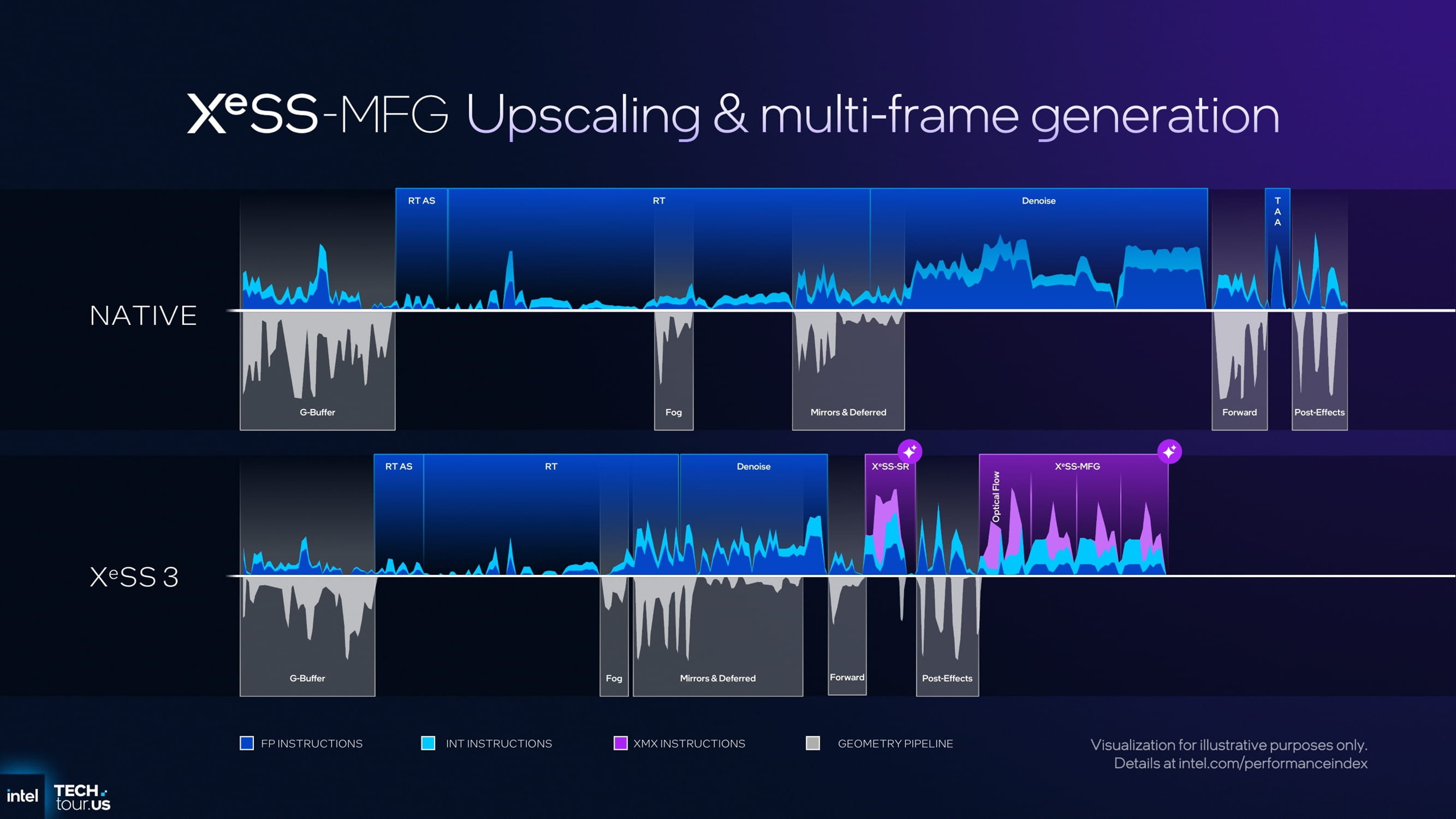
From a “theory‑stacking” perspective, you could jokingly sum up its potential like this:
PTL 12Xe + 4 * XessMFG > RTX 4060 + DLSS 3.5
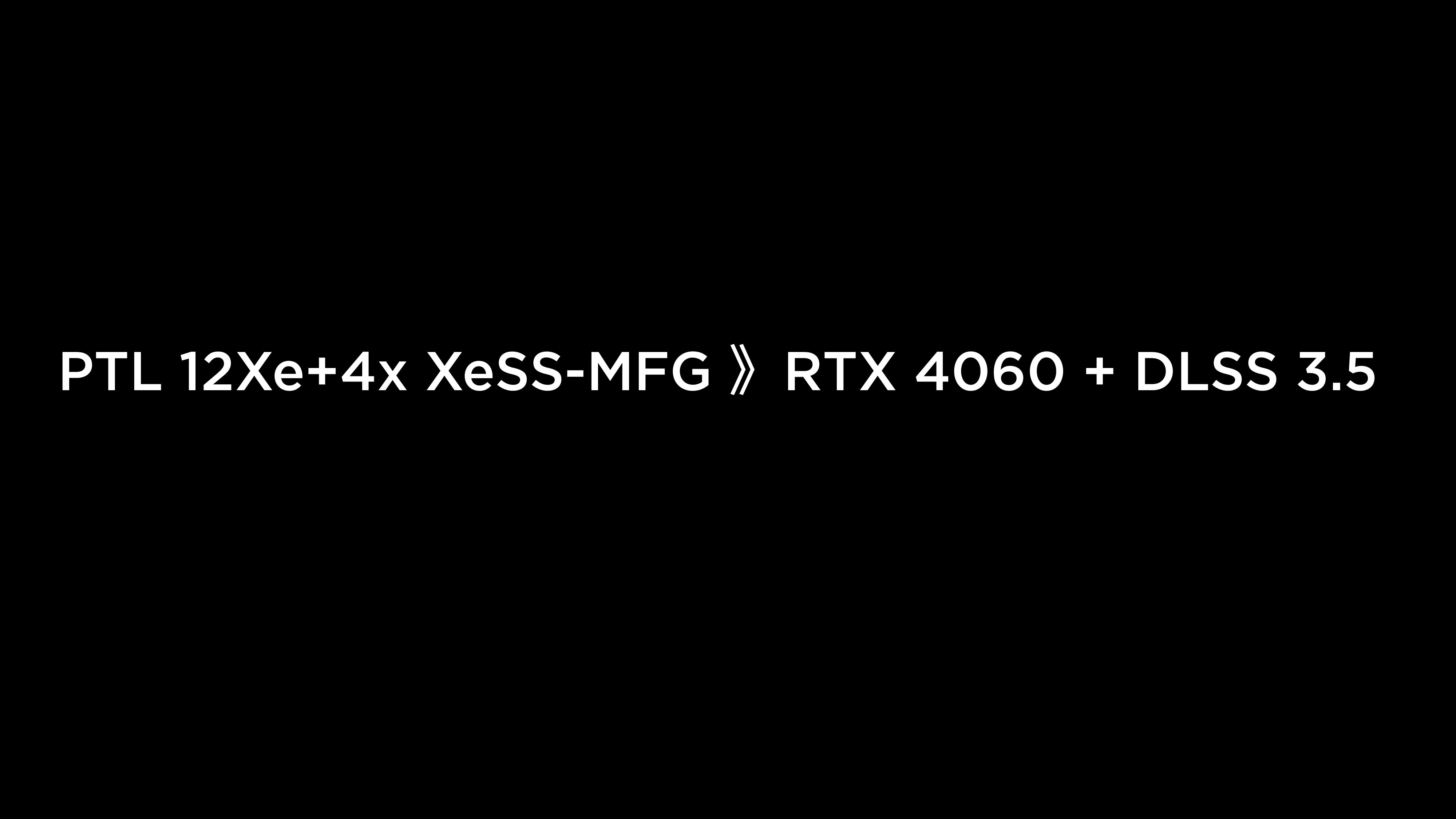
Of course, this is just playful exaggeration — don’t take that inequality literally.
All things considered, Panther Lake’s 12‑Xe iGPU offers extremely strong graphics compute performance and AI acceleration at the same power level, and Intel clearly has a lot of confidence in the competitiveness of its Xe3 architecture.
Over the next few years—especially as AMD shifts into its refresh cycle and their next‑gen iGPU scale regresses—the 12‑Xe version of Panther Lake could very well remain the most powerful integrated GPU in the laptop market for quite a long time.
So when it comes to Panther Lake’s iGPU performance this generation, it’s definitely something to look forward to.
Power Efficiency Design for Panther Lake
Now that we’ve looked at performance, let’s move on to Panther Lake’s power‑efficiency behavior.
This generation borrows heavily from Lunar Lake (LNL) in terms of power‑control philosophy, especially in how data is accessed and how tasks are scheduled across the system.
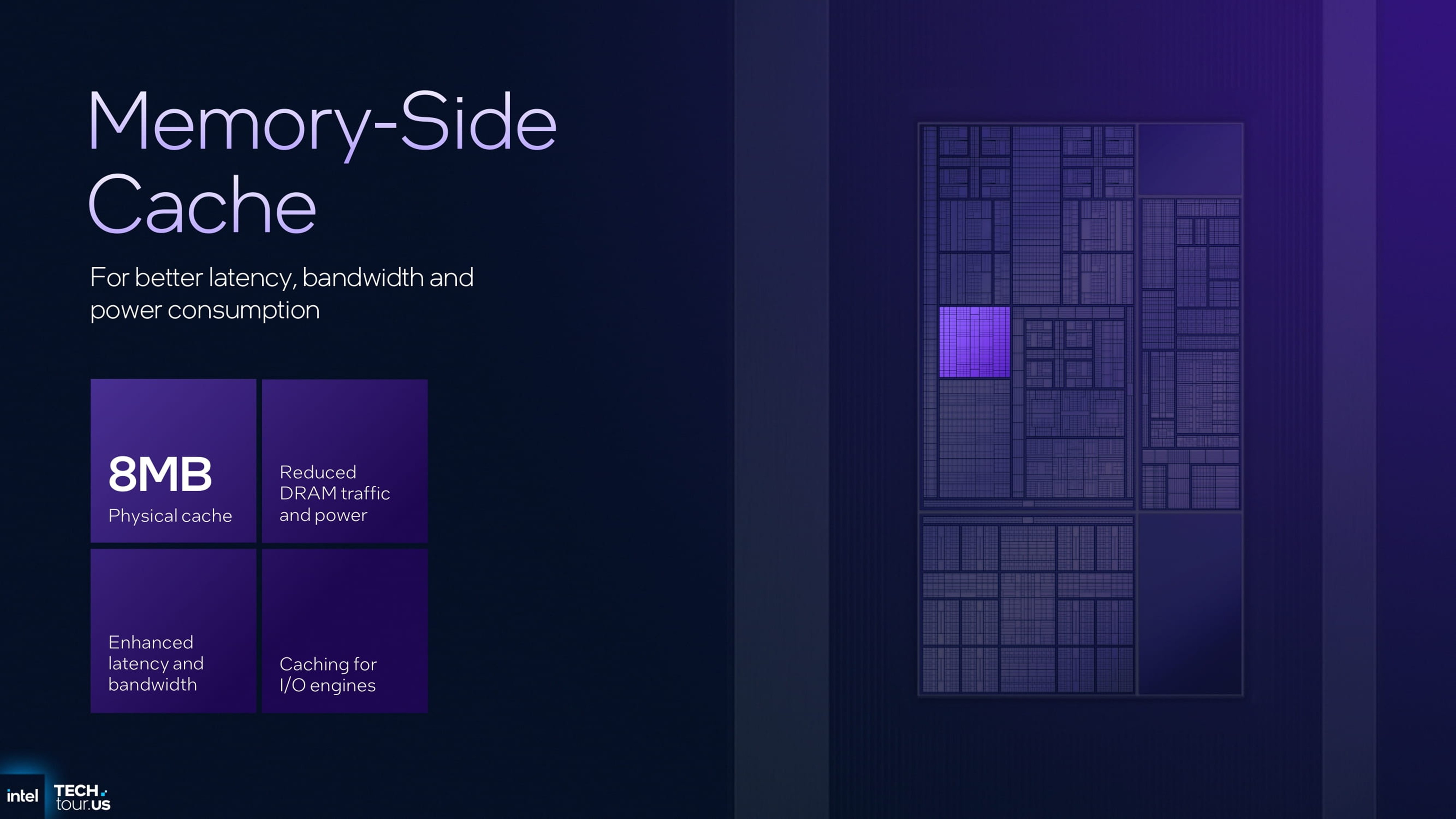
First, in the memory subsystem, Panther Lake continues to use the Memory Side Cache. This cache structure helps reduce DRAM access pressure, cutting down on DRAM traffic and bandwidth usage, which in turn lowers power consumption and reduces latency. By minimizing the power overhead caused by frequent memory‑bus access, this mechanism is especially beneficial for long‑running, light‑load tasks.
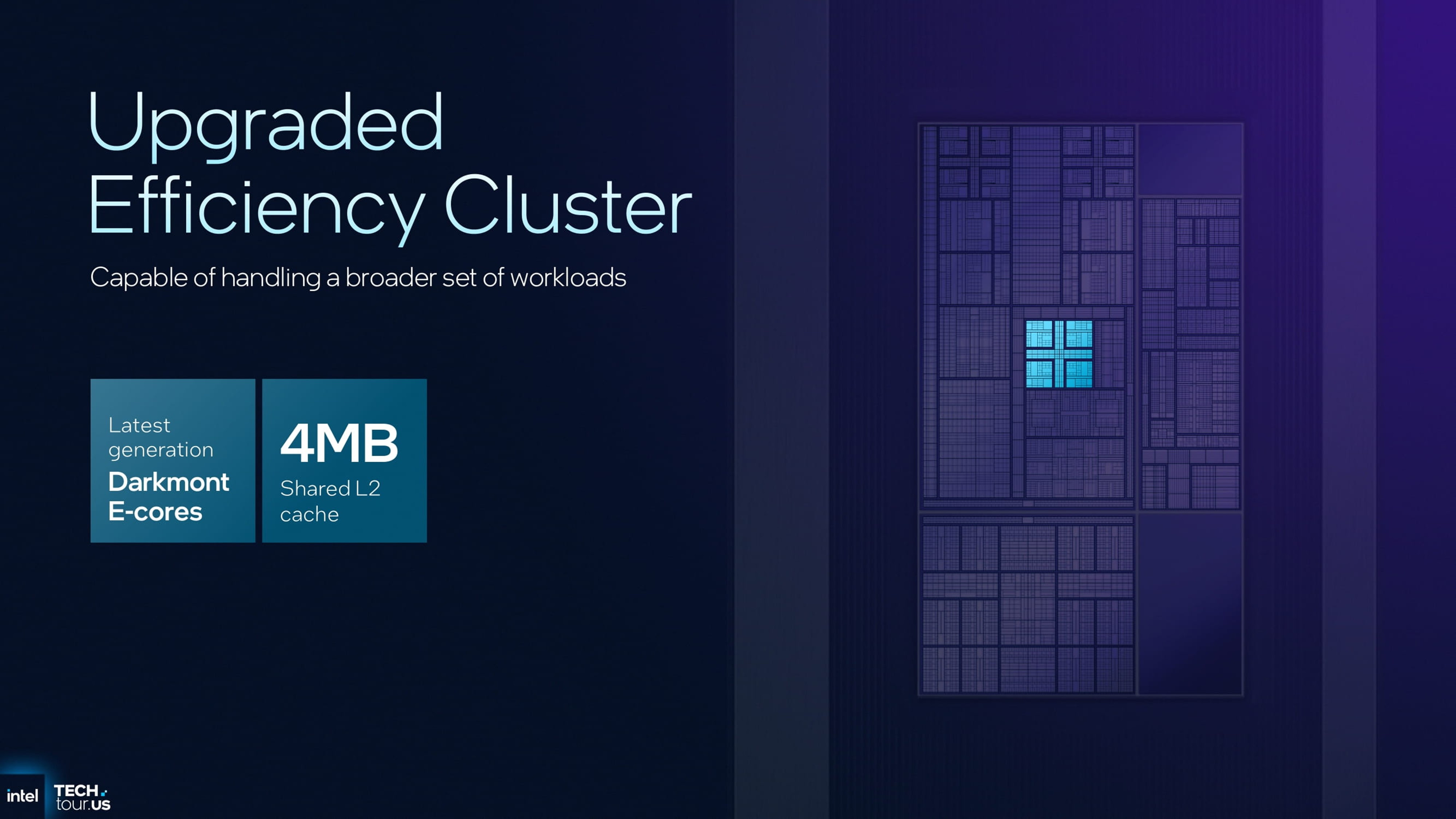
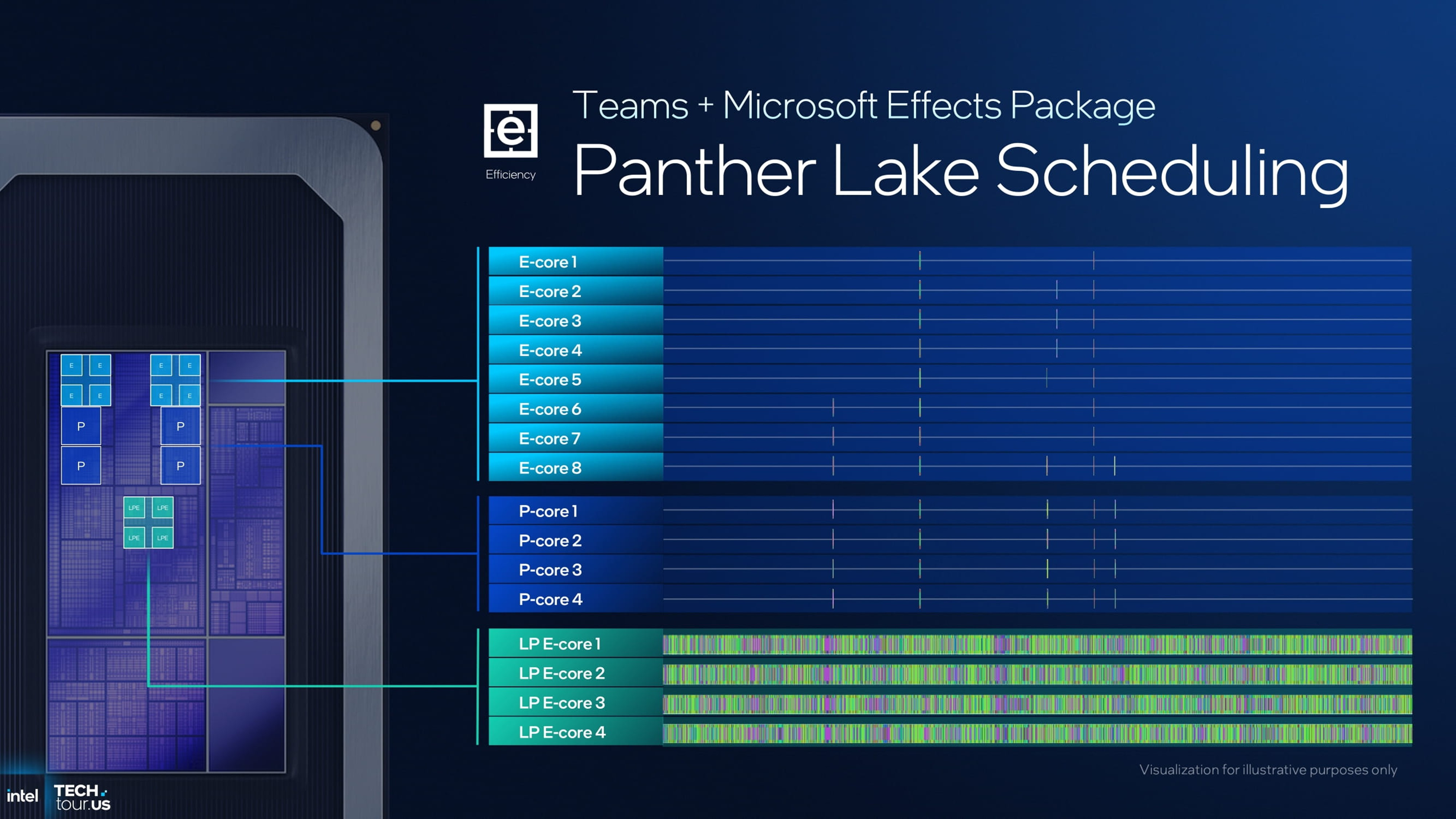
Next, the Low‑Power Island design is also carried over. This section is made up of dedicated LP E‑cores that handle background tasks and simple workloads. In low‑power scenarios, the system prioritizes routing work to this low‑power island to keep overall energy efficiency high.
However, Panther Lake’s core hierarchy is more complex than before (for example, the PLT 484 configuration uses a three‑tier structure), which naturally creates new challenges for task scheduling. To address this, Intel introduced a new generation of its Thread Director scheduling mechanism.
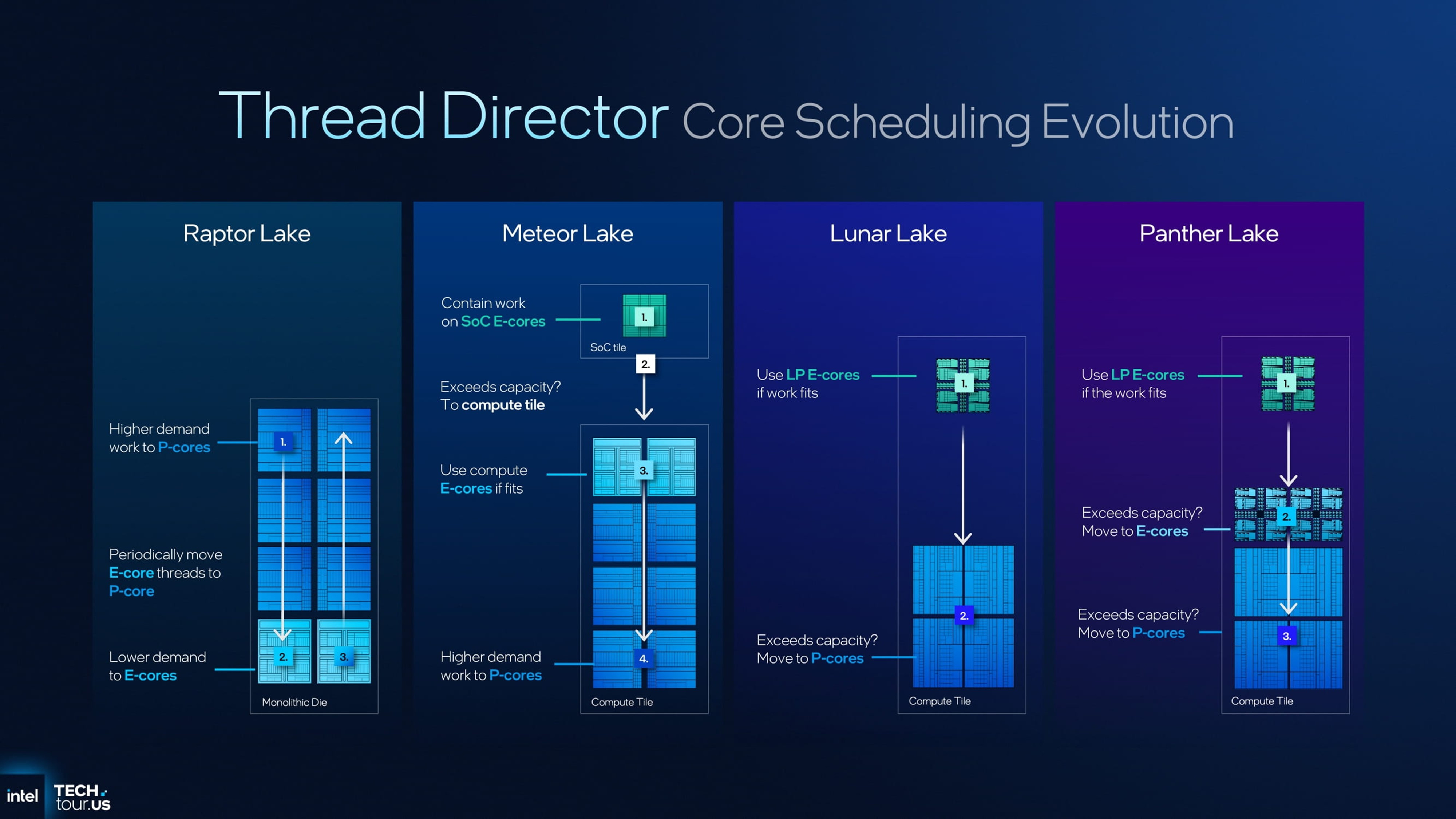
The updated Thread Director adjusts its priority logic as follows:
- Light workloads are assigned to the LP E‑cores first
- When computing demand increases, it gradually activates the regular E‑cores
- Only when high performance is needed does it finally wake up the P‑cores
In Intel’s demo, this mechanism is shown running scenarios involving multiple parallel apps like Microsoft Teams and the Microsoft Effects Package. Using such Thread Director’s tiered scheduling, almost all background tasks—video calls, camera processing, real‑time effects, and so on—get locked onto the efficiency cores, which significantly reduces overall system power draw.
Based on Intel’s live demo, in a mixed “office meeting” workload — running Teams, Excel, PowerPoint, multiple browser tabs, and video windows at the same time — total system power consumption was only 7.69 watts, which is lower than Lunar Lake’s 8.36W and far below Arrow Lake’s 11.5W. Under the same load, the slide clearly showed Panther Lake achieving noticeably better energy efficiency.
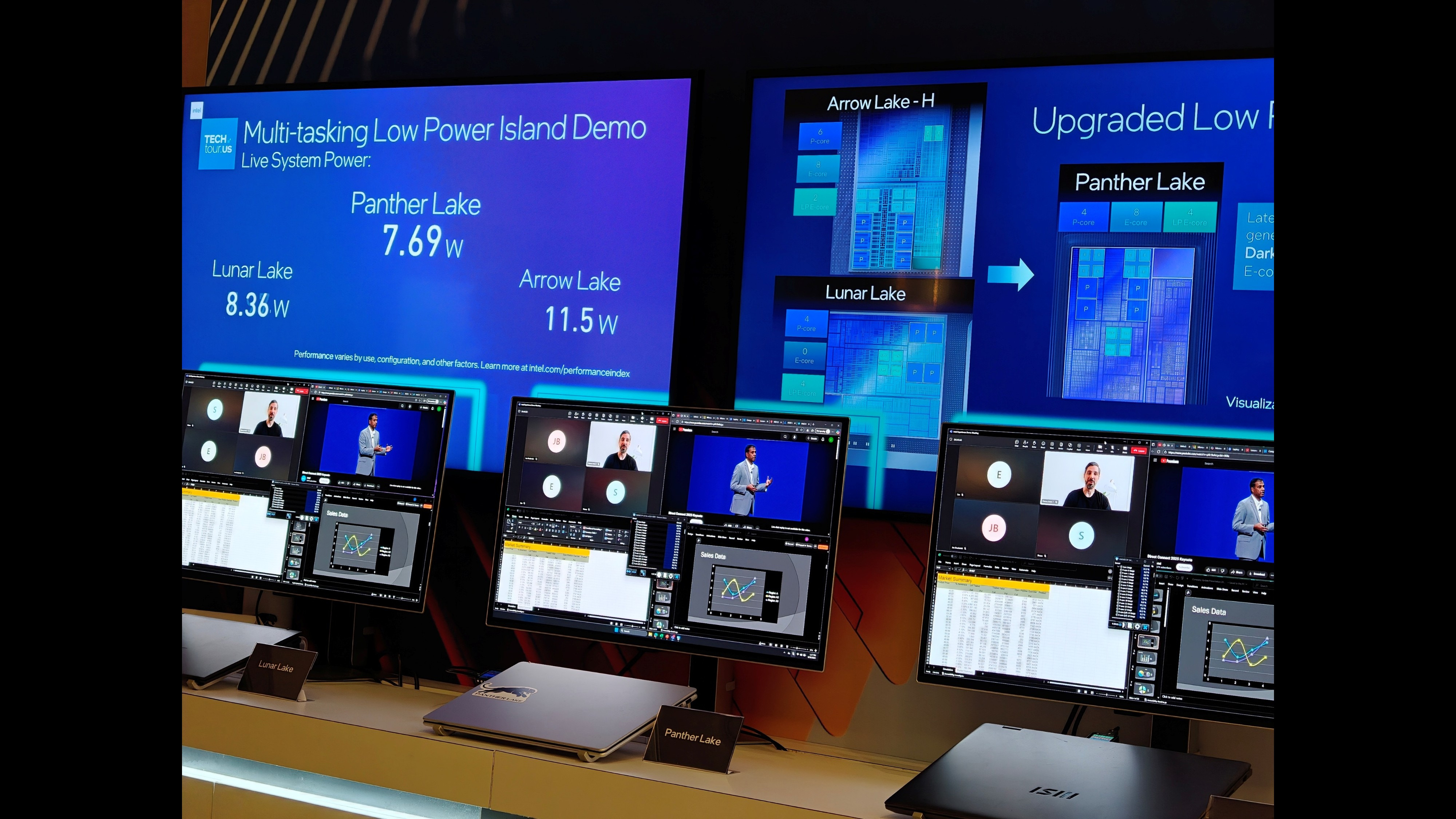
Of course, these numbers are for reference only. We need the real‑world testing once retail laptops arrive. One thing to keep in mind is that Lunar Lake laptops had a battery‑life advantage partly because they used an integrated PMIC power‑management design, which significantly lowered idle power consumption. Panther Lake continues to use the traditional DLVR power system, so its idle power draw may end up being higher. In other words, this kind of “low‑power demo” mainly shows Intel’s optimization direction, not a guarantee of actual battery‑life results in day‑to‑day use, which is far more complex.
Intel has also introduced a new E‑core‑first scheduling model aimed at unlocking more GPU performance. In gaming scenarios, the CPU intentionally reduces its foreground load, allowing more of the power budget to be shifted to the GPU for higher graphics performance.
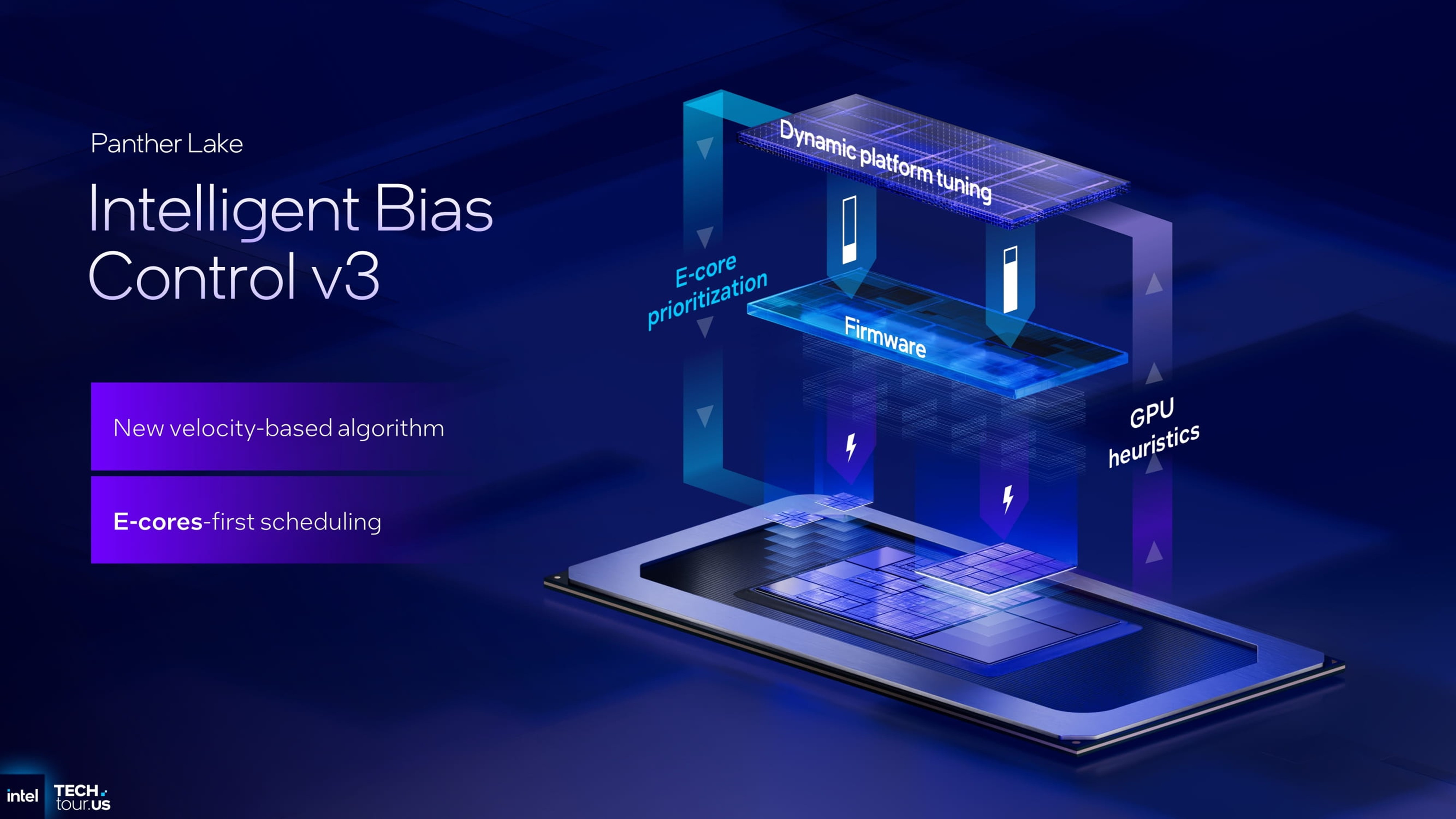
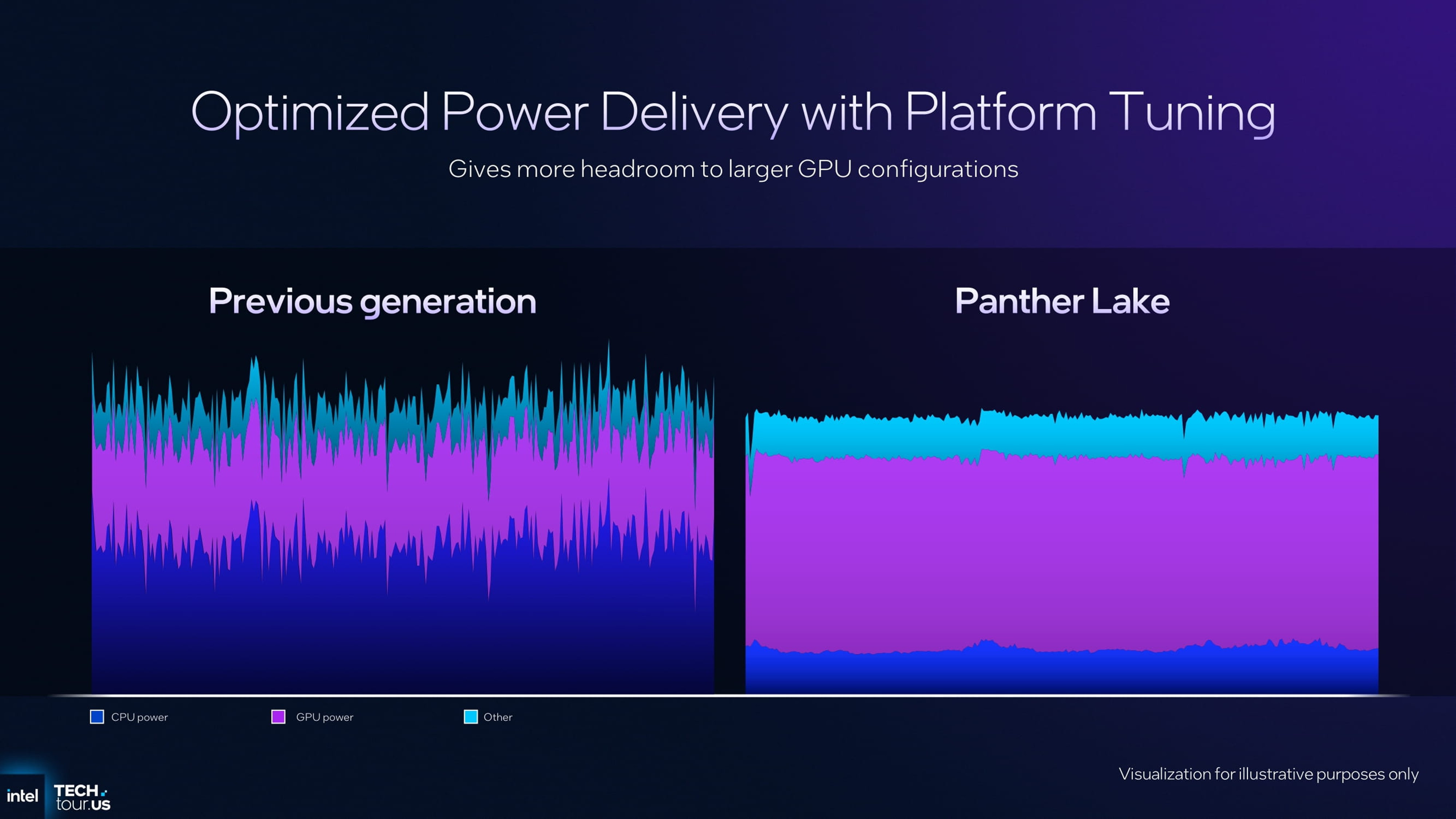
This kind of architectural strategy is especially beneficial for handheld gaming PCs — when you’re operating under very tight power limits, the less power the CPU uses, the more headroom the GPU gets. Intel already experimented with this approach on Lunar Lake, and they even showcased prototypes. In a typical 17W TDP scenario , the system can significantly improve 1% low FPS, making gameplay much smoother.
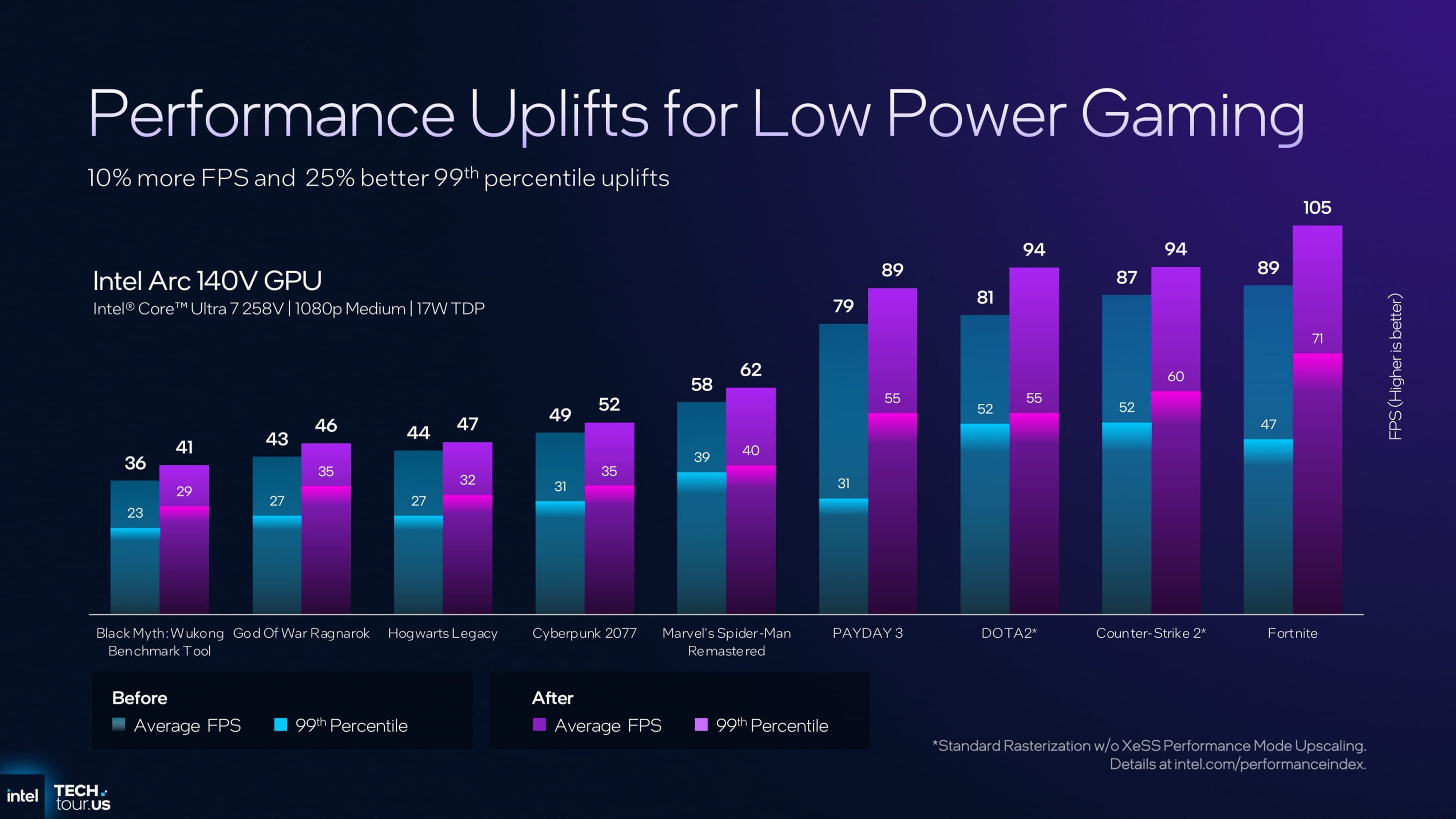
Panther Lake continues this same approach. The 12‑Xe iGPU version (PTL 484 + 12Xe) can also be used in handheld devices, and its scheduling behavior and power‑efficiency tuning are even better. Because of this, Intel plans to use this high‑end 12‑Xe configuration as the main option for future Intel‑based handhelds, instead of sticking with the Lunar Lake variant(4P 4LPE).
NPU Architecture and AI Capabilities
For users, one of the key upgrades in Panther Lake is its AI compute engine (NPU) .
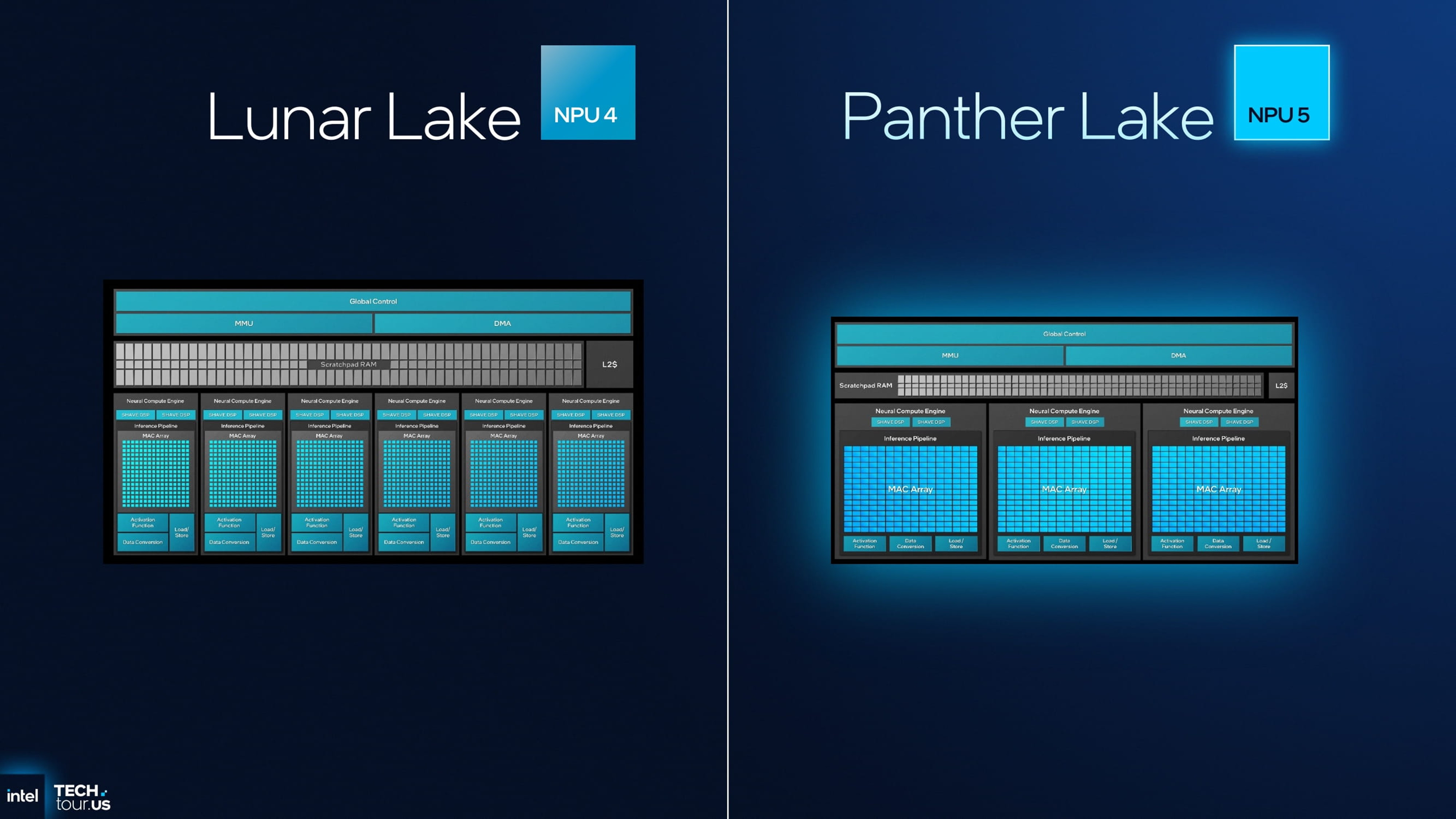
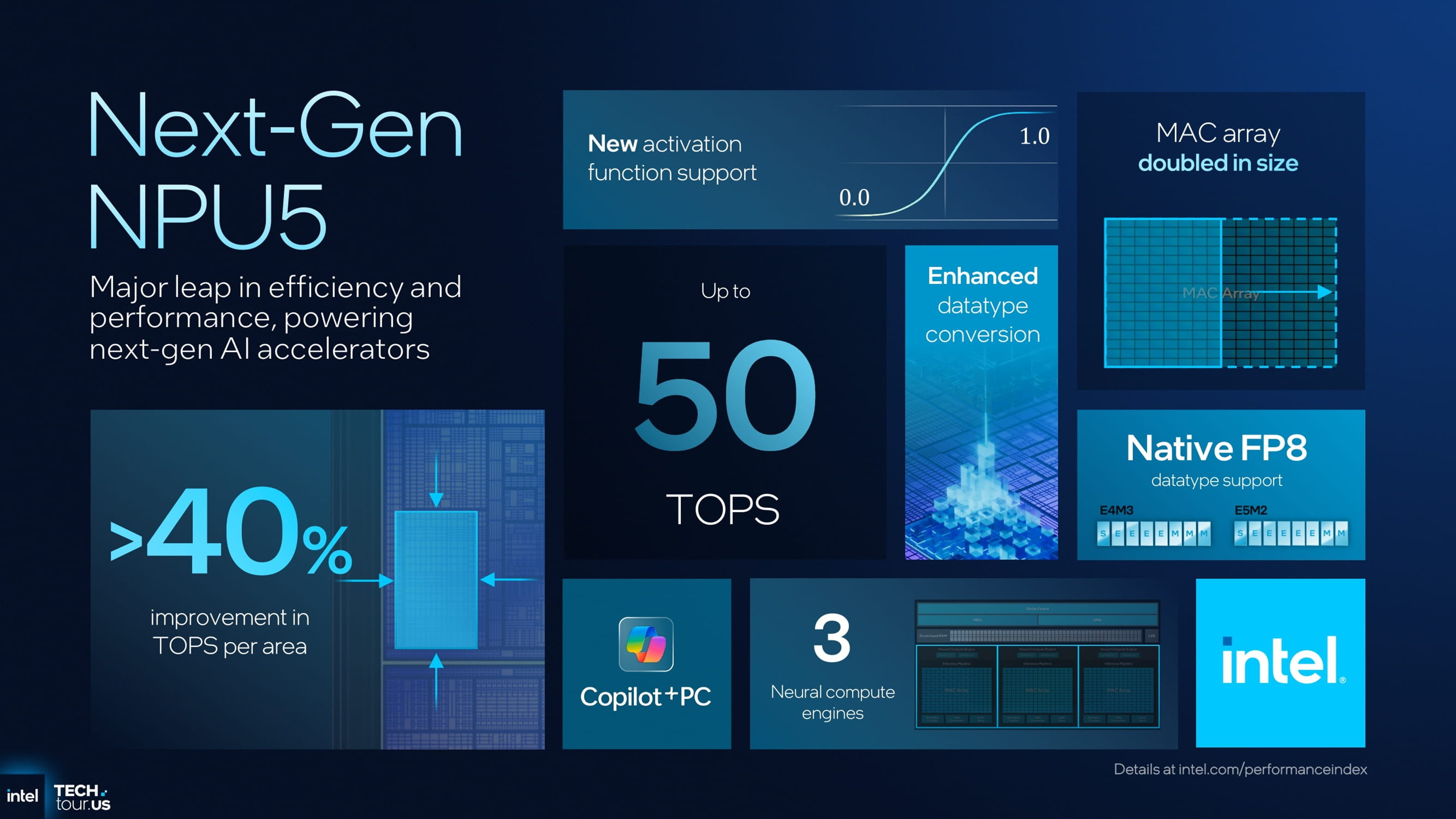
Panther Lake’s NPU moves from NPU 4 to NPU 5 , but from an architectural standpoint the changes are modest. In terms of raw performance, there’s actually no uplift — Lunar Lake delivered 50 TOPS, and Panther Lake also delivers 50 TOPS. Essentially the same.
The reason for this “flat performance” is tied directly to the Copilot+ PC certification standard. Microsoft requires any device supporting Copilot+ to have at least 40 TOPS of NPU compute. Since Intel’s existing NPU already clears that bar, there’s no real incentive to push the numbers higher. Competing platforms (including AMD) are expected to sit at around 50 TOPS for the next two years as well, so without competitive pressure, boosting NPU performance wouldn’t bring meaningful market benefits.
Because of that, Intel took a more practical, balanced approach with Panther Lake’s NPU design:
- The MAC Array (matrix‑multiply unit) is doubled in size to support higher theoretical compute density
- Meanwhile, the Neural Compute Engine (NCE) count is reduced from six to three, resulting in a more compact layout
This redesign allows the NPU to maintain the same compute throughput while reducing silicon area by about 40% . Since NPUs have increasingly become one of the biggest silicon consumers in modern SoCs, this directly lowers manufacturing and packaging costs.
Panther Lake is essentially optimized around a “good enough” strategy given limited die area and design budget — enough power to pass Copilot+ certification, but without letting the NPU consume excessive CPU/GPU silicon.
This more measured design also aligns with the reality of today’s AI PC ecosystem: most mainstream software doesn’t yet fully tap into more than 40 TOPS of local AI acceleration. Under those conditions, controlling NPU size and improving area efficiency is actually the more sensible choice.
Verdict: Who Is Panther Lake Really For? (from the translator Vitamin P)
Stepping back from process nodes and lane counts, what does Panther Lake actually mean for customers and OEMs?
Main strengths
- Class‑leading integrated GPU : The 12‑Xe Xe3 iGPU in the high‑end SKU can realistically reach RTX 3050 Laptop levels in 3DMark Time Spy, giving thin‑and‑light machines usable 1080p gaming and strong GPU compute without a dGPU.
- Power efficiency at mid power : Thread Director + LP E‑core “low‑power island” + Memory Side Cache make Panther Lake very competitive in mixed office and light‑load scenarios, especially around the 15–30 W range.
- High‑bandwidth LPDDR5X : The LPDDR5X‑9600 option on the 12‑Xe SKU gives the iGPU and NPU much more bandwidth headroom than most current laptop platforms.
- OEM flexibility : A unified three‑tile package and pin‑to‑pin compatibility across 8‑core and 16‑core variants let OEMs reuse the same board and chassis for multiple configs, cutting validation cost and time‑to‑market.
Key trade‑offs and weaknesses
- Modest CPU uplift : Single‑core gains over Arrow Lake‑H are only in the mid single‑digits, and multi‑core improvements mostly come from more cores and a better node, not from a big architectural leap.
- PCIe lane cuts : 20 lanes on the mid‑range and 12 lanes on the high‑end limit high‑bandwidth expansion (e.g., OCuLink, multiple high‑speed NVMe drives plus rich I/O).
- LPDDR5X‑only on the high‑end : Great for bandwidth, but it removes upgradeable memory and can raise BOM costs, especially in markets sensitive to price and repairability.
- No desktop / HX tier : Desktop users and ultra‑high‑power gaming laptops will still have to look at Arrow Lake‑S / Arrow Lake‑HX or wait for Nova Lake‑HX.
Who should care — and who shouldn’t
- Thin‑and‑light office and productivity users : The 8‑core PTL404 and 16‑core 4Xe versions are strong fits if you want good battery efficiency, smooth office/multitasking performance, and don’t care about a dGPU.
- Handheld gamers and compact gaming devices : The 16‑core + 12‑Xe SKU is particularly attractive for handheld PCs and very small gaming laptops, where a strong iGPU plus E‑core‑first scheduling can deliver much better performance per watt than a small dGPU.
- Premium ultraportables without dGPUs : Users who want one machine for work, light content creation, and 1080p gaming will likely get the most out of the 12‑Xe high‑end configuration.
- dGPU gaming laptops and workstation buyers : If you are planning to pair the CPU with a powerful RTX/Radeon dGPU and need lots of PCIe lanes and maximum CPU throughput, Arrow Lake‑H/X or AMD’s Dragon Range/Strix Point platforms may still be the better choice. Panther Lake’s mid‑range 16‑core SKU is tuned more for “good enough CPU + dGPU” rather than absolute CPU or I/O headroom.
- Value‑focused buyers : If you don’t care about integrated‑GPU performance and just want the best price‑to‑performance ratio, refresh‑cycle AMD APUs or discounted Arrow Lake / Lunar Lake designs may offer better value once Panther Lake launches and starts pushing down prices.
In short, Panther Lake is not a CPU‑performance revolution. It’s a platform‑level realignment: Intel is trading some CPU and I/O ambition for a much stronger iGPU, better power efficiency, and simpler OEM design.
If those are the things you care about, especially in thin‑and‑light or handheld form factors, Panther Lake is absolutely worth watching.
If you’re chasing maximum CPU throughput and PCIe expansion above all else, Panther Lake is not for you—Arrow Lake‑H/X or upcoming Nova Lake‑HX will be more appropriate.
And with that, we’ve basically covered Intel’s entire Panther Lake family.
The end.
Keywords: Panther Lake Intel Core Ultra 300 12-Xe iGPU Panther Lake vs Arrow Lake Core Ultra 300H specs performance CPU for integrated graphics gaming Panther Lake laptop CPU Thin‑and‑Light